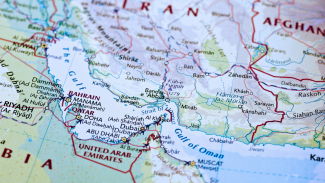
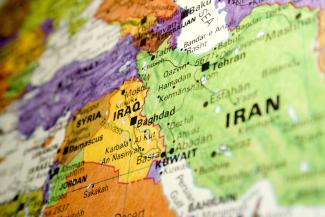
The death of Iran’s Supreme Leader Ali Khamenei in US and Israeli air strikes on Saturday has created enormous uncertainty about Iran’s political future, but the path that Iran takes will have implications for its own economy, the wider region, the global …
2nd March 2026
The jump in energy prices since the weekend’s military attacks is a mild stagflationary shock for the euro-zone. If the increase is sustained, it would add around 0.3 percentage points to inflation, and activity would be fractionally weaker. This would …
Following the effective “closure” of the Strait of Hormuz in the wake of renewed conflict in the Middle East, this Update answers five key questions about the potential impacts on global energy markets. How much of the world’s energy flows pass through …
Weak net lending in January highlights a slow start to the year for investment Net lending secured against commercial property slowed markedly in January, reaching just £0.87bn, its lowest monthly outturn since March 2025. While that drove a fall in the …
This page has been updated with additional analysis since first publication. Good start to the year, but Middle East developments may mean it doesn’t last January’s money and lending data support other evidence that suggests the economy strengthened at …
The longer the US/Israeli strikes go on the greater the risk to both US Treasuries and equities, in our view. But the US dollar might continue to fare well. We covered our broader thoughts on the macro implications of the Iran war earlier today . But from …
Iran conflict …
The global economic impact of conflict in the Middle East will hinge on its effect on energy markets. If oil stays near $70-$80 per barrel, fuel effects will boost headline DM inflation by only about 0.4 percentage points and the broader economic fallout …
At 10am GMT today, we’re hosting a short online briefing to assess what this weekend’s developments in the Middle East mean for the global economy and markets. (Register here .) We’re also hosting an in-person property roundtable event at our London …
Slowdown masks unbalanced growth Although Turkish GDP growth slowed sharply to 0.4% q/q in Q4, growth appears increasingly unbalanced, with consumer spending and imports strong, while exports fell. Taken together with the rise in oil prices on the back of …
The 0.6% annualised contraction in fourth-quarter GDP stole the headlines this week but the details were arguably much more encouraging than the third quarter, when GDP rose by 2.4%. Thanks partly to a rebound in household spending, domestic demand rose …
Australian house prices pared their gains in February, as housing demand softened a touch. Although the slowdown was driven largely by Sydney and Melbourne, we suspect it will become more broad-based in the months ahead. Allowing for seasonal swings, …
The weekend’s US and Israeli strikes on Iran have crystallised several key risks for the global economy and markets. In response, we hosted a short online briefing on Monday 2nd March to assess the implications and answer your …
1st March 2026
The economic fallout from the attacks by the US and Israel on Iran today will depend on how long the conflict lasts, the scale of Iranian retaliation and the spillovers to the oil market. A limited set of strikes could plausibly send oil towards $80pb, …
28th February 2026
China Chart Pack (Feb 26) …
27th February 2026
Tariff uncertainty persists The initial response to last Friday’s Supreme Court ruling that its IEEPA-related tariffs were illegal suggested that the Trump administration had been carefully planning for that outcome. Within a couple of hours, President …
The 10-year Treasury yield tried and failed to break meaningfully below the 4% mark repeatedly last year and is making its first attempt of 2026. We don’t think that it will happen this time either. The 10-year US Treasury yield has today slipped below 4% …
SA Budget: Growth needed to stabilise debt The South African government opted – as expected – to give away the recent revenue windfall at this week’s 2026 Budget. That it was able to do so reflects the remarkable turnaround recently in the public …
Implications of the new US tariff regime Tariffs have once again taken centre stage after the US Supreme Court struck down President Trump’s IEEPA tariffs, prompting Trump to impose a baseline 10% tariff under Section 122 (and threatening to raise this to …
Is China’s latest Five-Year Plan about to reset its economic model and tackle the imbalances weighing on both the domestic and global economy? Speculation always builds ahead of a new Five-Year Plan. But this time, the stakes feel higher. With growth …
India’s revamped national accounts data show that the economy in nominal terms is slightly smaller than previously thought, although the big picture remains intact. Relative to GDP, the budget and current accounts deficits are still low, though a slightly …
Signs of a boost to oil supply herald lower prices Looking ahead to OPEC+’s meeting this weekend, media reports indicate that the group is likely to increase its oil output quotas by 137,000 bpd for April. Recall that the group’s output quotas were paused …
Last week’s US Supreme Court ruling on tariffs and the subsequent imposition of a new 10% universal tariff has added to the policy confusion but does not significantly alter the economic outlook. To recap, the trade agreement struck between the US and EU …
Strong PPI illustrates that elevated inflation still a concern The 0.5% m/m increase in final demand PPI in January is another illustration that elevated price inflation remains a threat. Excluding food and energy prices, which were pulled down by a 5.5% …
Bank will put more weight on rise in domestic demand than drop in GDP The 0.6% annualised decline in fourth-quarter GDP was not as bad as it looked, with most of the drag coming from weaker inventory building, whereas domestic demand growth rebounded to …
Euro-zone inflation to tick up, but unlikely to worry ECB National inflation data released so far suggest that euro-zone headline inflation rose in February and that the core and services rate s were little changed . That is unlikely to change the ECBs …
We're hosting a 20-minute online briefing at 3pm GMT on Tuesday 3rd March to answer your questions on what the Chancellor's Fiscal Statement means for the politics, the economy and the financial markets. (Register here .) By-election loss could push the …
Inflation surprise shouldn’t derail Copom’s easing cycle The smaller-than-expected fall in inflation in Brazil to 4.1%y/y in the first half of February shouldn’t prevent the central bank from kicking off its easing cycle next month. But it does mean that …
Fiscal policy and rebalancing agenda will be key Today’s Politburo meeting didn’t elaborate on the economic policy agenda laid out at the Central Economic Work Conference in December. But the details will soon be fleshed out at the annual gathering of …
Strong Q4 GDP print confirms end to easing cycle India’s revamped national accounts data show that the economy in nominal terms is smaller than previously thought, but they still show a rapid pace of real GDP growth over recent quarters. We will address …
Russia’s militarised economy struggling Tuesday marked the fourth anniversary of Russia’s invasion of Ukraine. We published an in-depth report looking at the effects of the war on Russia’s economy which can be found here . There are five key takeaways …
Overview – Property yields saw no movement in 2025 and we expect that stability to continue over the next few years. We think the 10-year gilt yield will see a small fall to around 4.25% by the end of 2026, but the current narrow spread against property …
Supreme Court creates more uncertainty Recent tariff changes, which saw the IEEPA tariffs replaced with a universal 10% Section 122 tariff will reduce the tariff burden on Asian countries more than on other parts of the world. China emerges as the largest …
I will return with my usual note on Monday. In the meantime, given the volume of client enquiries prompted by Citrini’s paper on the consequences of an AI-driven “abundance of intelligence” - and the market volatility that has accompanied it - a brief …
Tariff saga highlights unreliability of US as a partner We’ve covered the changes to US tariffs – with a new universal 10% Section 122 tariff replacing the IEEPA tariffs that were deemed illegal by the US Supreme Court – across various publications (see …
Tensions with China continuing to escalate The tensions between China and Japan show no signs of abating. China’s government this week prohibited exports of “dual-use items” to 20 Japanese firms, with an additional 20 firms placed on a “watch-list”. …
Investment surge to prop up private demand Australian CPI data showed that trimmed mean inflation rose from 3.3% to 3.4% in January. Moreover, if monthly price increases continue at their current pace, underlying inflation will accelerate further still. …
Encouraging data strengthen case for further BoJ tightening On balance, the January activity and inflation figures suggest that the BoJ won’t wait much longer before hiking rates again. Taking industrial production first, the 2.2% m/m rise in January was …
The average tariff rate will decline following the Supreme Court’s IEEPA ruling, but not by enough to materially change the near-term outlook for the economy. That hinges on AI-related investment and the resulting productivity gains, which we expect to …
26th February 2026
We estimate that non-farm payrolls rose by 80,000 in February, but that the unemployment rate will nonetheless rebound to 4.4%. Stronger momentum mainly a health care story The 130,000 jump in payrolls in January was due to a 124,000 surge in health care …
US-Iran talks back underway The US and Iran resumed talks in Geneva today. Discussions are set to focus on a proposal put forward by Tehran regarding its nuclear programme. It remains to be seen how the US will view the proposal, but the build-up of US …
Asia Chart Pack (February 2026) …
The Nigerian naira has been one of the strongest performing EM currencies since the start of the year, helped by an improved balance of payments position. But the naira’s rally is starting to hurt Nigeria’s external competitiveness and, taken together …
Emerging Markets Capital Flows Monitor (Feb. 2026) …
The past week’s shifts in US tariffs have put a large number of Chinese manufacturers back on a level playing field in the US market with other non-US producers. These lower rates look likely to remain in place for an extended period. But the average US …
Assessing the impact of Trump’s climate pushback The Trump’s administration’s repeal of the “endangerment finding” appears to be another blow to climate policy in the US. For context, the endangerment finding declared that greenhouse gas emissions were …
ESI points to decent growth, but labour market still loosening February’s EC survey suggests that the economy is expanding at a decent pace and that price pressures in the services sectors are still fairly strong. But the labour market is still …
After a weak start to the year, we expect Chinese equities to regain their footing over the coming months, partly because their valuations aren’t especially stretched. Moreover, we expect the AI rally to continue this year, providing a further tailwind …
The key development from today’s meeting of the Bank of Korea was not the widely expected decision to keep the policy rate at 2.50%, but the shift to a new six-month forward-guidance “dot plot”. While the median projection points to rates being on hold …