
- Timely indicators underscore the severe hit dealt to the Gulf economies by the war, with sharp declines in oil output alongside clear weakness in non-hydrocarbon sectors. Even if the war ends soon, we expect all six Gulf states to record negative GDP growth this year, of 5-10%.
- Figures released yesterday by OPEC provided the first strong steer on disruption to oil production in the Gulf economies from the war. The conflict has disrupted traffic through the Strait of Hormuz and, with storage facilities in the Gulf close to capacity, many producers have been forced to shut down wells.
- As a result, oil output fell sharply last month. The steepest declines were recorded in Kuwait and the UAE, where output fell by 53% and 45% respectively. (See Chart 1.) Saudi oil production held up better thanks to its ability to divert its oil exports via the East-West Pipeline to its Red Sea port of Yanbu. But even there, oil production dropped by more than 20% last month, to just 7.8mn bpd.
- Even if the ceasefire holds and traffic through the Strait resumes, hydrocarbon production in the Gulf will take time to fully recover. For those wells that have been shut down, it’s not as simple as just turning the taps back on. And there is likely to be some lingering damage to production and/or refining facilities. Attacks on its energy facilities have already knocked out 17% of Qatar’s LNG output for the next 3-5 years.
- Meanwhile, conditions in non-hydrocarbon sectors in the Gulf have deteriorated. March’s PMI surveys (which cover non-oil activity) fell sharply across the region. (See Chart 2.) Qatar’s PMI was particularly weak at just 38.7, well below the 50-mark that separates expansion from contraction and the lowest reading since the pandemic. At the other end of the spectrum, the UAE’s PMI held up well, despite its greater concentration of sectors vulnerable to the effects of the war. We would caution, though, that the PMIs are diffusion indices and so gauge the breadth, rather than the magnitude, of the hit to activity.
- Hard data from Saudi Arabia suggest that consumer spending there has proven resilient so far. Weekly figures show that, over March as a whole, point of sale transactions rose by more than 7% in 3m/3m terms. In part, we suspect that reflects the fact that Saudi Arabia’s largest population centres, such as Riyadh, Jeddah and Mecca, have been less affected by Iranian attacks. (See Chart 3.)
- Nonetheless, other indicators point to weak domestic demand across the region. Early trade figures from key economies show that their exports to the Gulf economies fell sharply last month. (See Chart 4.) Korea’s exports to the “Middle East” (which includes some of the smaller non-Gulf economies as well as Egypt) were down by nearly 50% y/y. It’s a similar pattern elsewhere. Vietnam’s exports to the Gulf fell by around 40% y/y, whilst those from Brazil dropped by more than 30% y/y.
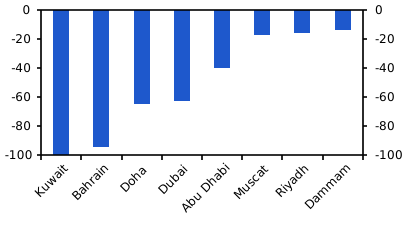
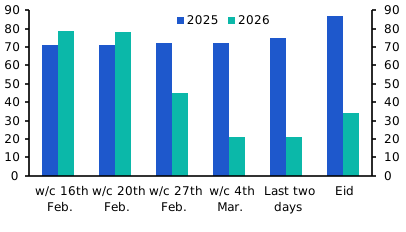
- Travel and tourism sectors have been hit particularly hard. Data from FlightRadar show that, in aggregate, “tracked” flights in the Gulf are around 50% below their pre-war levels. But there remain no flights in Kuwait and only a limited number in Bahrain. Saudi has been more insulated, with the number of flights down by a more modest 15% or so. Key transit hubs, such as Dubai, Abu Dhabi and Doha, sit somewhere in the middle, with flights down by 40-60%. (See Chart 5.) Relatedly, hotel occupancy is well below normal levels. In Dubai, occupancy rates are close to 20% compared to typical levels of 70-80%. (See Chart 6.)
- Overall, the early evidence suggests that the war has dealt a substantial blow to activity in both hydrocarbon and non-hydrocarbon sectors across the Gulf. Under our baseline scenario, which assumes an end to war within the next couple of weeks, we have pencilled in contractions of GDP in the Gulf of 5-10% for this year as a whole. (See here.)
Chart 1: Change in Oil Production (Feb. – Mar., %) | Chart 2: PMIs |
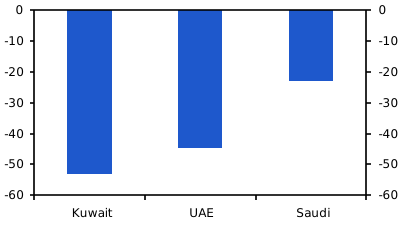 | 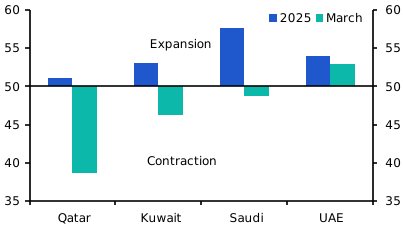 |
Chart 3: Saudi Point of Sale Transactions (SA, % 3m/3m) | Chart 4: Exports to the Gulf (March, % y/y) |
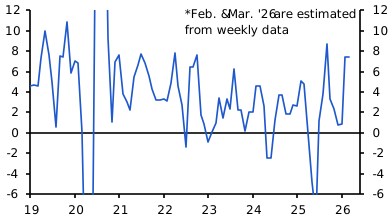 | 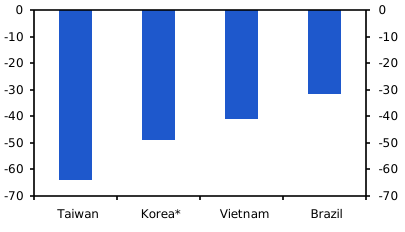 |
Chart 5: Number of “Tracked” Flights | Chart 6: Hotel Occupancy Rate in Dubai During Ramadan and Eid (%) |
 |  |
Sources: CEIC, LSEG, FlightRadar, CoStar, OPEC, Capital Economics |