
We’re continuing to support client decision-making during the Middle East conflict with comprehensive but concise analysis and daily online briefings. All of our key analysis on this crisis can be found here. Below are some highlights from our coverage on Friday, 13th March.
-
Macro & market scenarios
Our scenarios – covered by the Financial Times, Wall Street Journal, among others – outline three potential conflict pathways and their global macro and market implications.
-
How markets are holding up
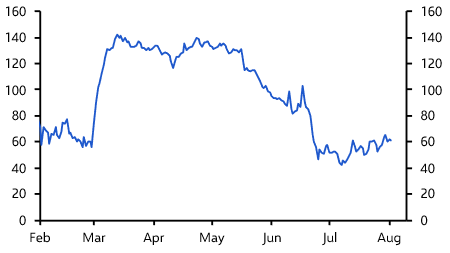
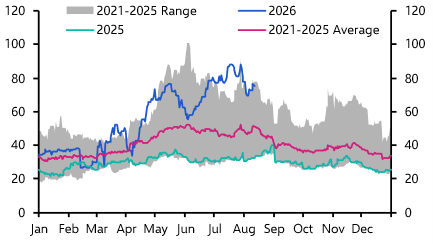
The nightmare scenario for energy markets has been reflected in historic volatility and significant uncertainty about the price outlook. Reopening the Strait of Hormuz is key. In contrast, financial markets have been relatively calm.
- Russian sanctions relief and IEA releases can't compensate for a closed Strait of Hormuz
- Our measure shows a ~20% chance of $100 oil in three months, but uncertainty is huge
- Big tech has outperformed since the war began; our base case is a short war and continued AI enthusiasm favouring these sectors.
- The war has lifted market volatility, but core money markets remain stable; private credit shows strain but little systemic risk.
-
A busy week in central banking
Central banks will (mostly) stand pat at this coming week's meetings, though their communications around the energy shock will be telling. We’re holding Drop-Ins on the Bank of Japan and on the Fed, ECB and Bank of England.
-
How economies will fare
How economies emerge from this crisis will largely depend on whether they are net energy exporters or importers – unless they are directly involved in the conflict.
- The US could weather a world of $100 oil, but the Fed would have to respond
- China can withstand the crisis better than its status as the world’s top oil importer implies
- The UK economy is already coming under stagflationary pressure
- The Gulf economies will see negative growth this year under all three of our scenarios
- Asia is most exposed to the energy shock; governments that can’t cushion it will have to let prices rise.
- And in other news...