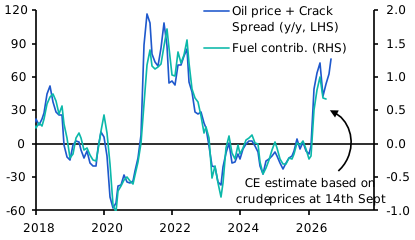
The rise in the price of oil to over $100 per barrel is the last thing central banks across the advanced economies want to see. The European Central Bank met last week and raised interest rates by 25 basis points, citing upward revisions to inflation forecasts driven in part by higher energy costs. This week will see meetings of the Federal Reserve, the Bank of England and the Bank of Japan. The impact of $100pb oil on inflation will vary from country to country but across advanced economies as a whole energy will add about 1.25%-pts to headline inflation in the coming months. (See Chart 1.) We think headline inflation will remain between 3.5 and 4.0% y/y in the US, UK and euro-zone until at least the second quarter of next year.
Chart 1: Fuel Prices and Contribution to DM inflation |
 |
Sources: LSEG, Capital Economics |
Core inflation, particularly in Europe, is likely to be softer. But in the US, where the labour market remains relatively tight and there are also inflationary pressures associated with the AI investment boom, inflation is likely to be stronger. We expect US inflation to stay above the Fed’s 2% target on the core PCE measure through this year and next. While the Bank of England may just about manage to avoid raising rates over the next six months, the Fed and the Bank of Japan are likely to follow the ECB this week in raising rates. And all three central banks are likely to hike again this year.
The feedback loop
It would be wrong to overplay the impact of $100pb oil on the global economy. But it does illustrate how supply shocks can complicate life for central banks. After several years in which inflation has run above target it has become harder for policymakers to “look through” the otherwise temporary effects of higher inflation caused by supply shocks. More importantly, in a world of high public debt and large fiscal deficits, there is a potential feedback loop through the bond market that could make a difficult situation considerably worse.
This is not to say that we are on the cusp of a bond market crisis. But developments over the past few weeks illustrate how problems could develop.
The mechanism is relatively straightforward: an adverse supply shock, such as a sharp rise in oil prices, pushes up inflation expectations in markets and, after years of missing inflation targets, central banks feel compelled to respond by hiking interest rates. Higher interest rates then feed through into higher government bond yields which in turn raises concerns about fiscal sustainability, particularly in economies where debt levels and fiscal deficits are already high. Those concerns can push bond yields higher still, creating a self-reinforcing cycle in which rising yields feed fiscal worries, which in turn drive yields higher.
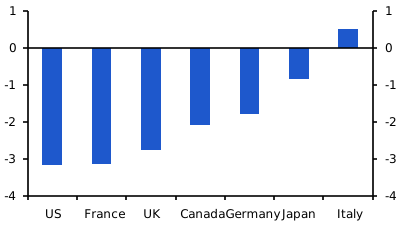
This is the sort of dynamic that can turn a one-off shock into something more disruptive. The fiscal position of most advanced economies is fragile. As it happens, despite its image as a fiscal miscreant, Japan is something of an exception. Its gross debt burden is extremely high, but its net debt position is considerably less severe, its primary budget deficit is small and its debt ratio is falling. (See Chart 2.)
Chart 2: General Government Primary Balances (% of GDP) |
 |
Sources: IMF, Capital Economics |
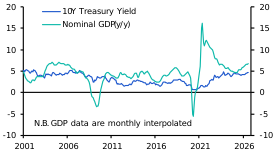
The US is a more interesting case. The sustainability of US public debt depends not just on the interest rate paid on that debt, but also on the growth rate of the economy. So far, the rise in Treasury yields has broadly tracked the improvement in the outlook for nominal GDP growth. (See Chart 3.) In that sense, this is not yet a self-fulfilling fiscal crisis.
Chart 3: 10Y Treasury Yield & US GDP Growth (%) |
 |
Sources: LSEG, Capital Economics |
But bond markets can impose their own discipline on governments when investors lose confidence in fiscal sustainability.
A warning for policymakers
Clinton-era strategist James Carville’s line about wanting to be reincarnated as the bond market because “you can intimidate everybody” should remind this generation of political leaders that when markets begin to move on concerns about fiscal credibility, their responses can make matters worse.
Treasury Secretary Scott Bessent has dismissed concerns about his bond market interventions, saying that “if the Bloomberg Terminal bros are unhappy with what I’m doing, that’s too bad”. Meanwhile, President Trump has pledged dividend cheques to households if Republicans retain control of Congress after the midterms, a proposal that could cost well over $1 trillion. Neither reassures investors about the US fiscal trajectory or the credibility of its policymaking.
The oil shock may prove manageable. But it illustrates how, in a world more vulnerable to supply shocks and burdened by high public debt, risks can interact and intensify through the bond market. In fact, there is a good case to be made that the key risk from a global macro perspective is less the initial shock than the feedback loop it could set in motion.
In case you missed it
Last week we launched a major new research series on China Shock 2.0. Mark Williams explained why overcapacity in China and the trade surplus that it feeds are sustained by policy choices made in Beijing that are likely to persist for many years…
…and Leah Fahy explained how China’s export gains extend well beyond strategic goods.
Next week we will be holding events in Montreal, Toronto and Boston on the macro and market impact of AI. Sign up here.