Client visits in New York last week offered a timely, if expensive, reminder of how inflation affects economies. Before the pandemic, a beer in a Midtown bar would cost $10; now you would be lucky to see much change from $20. And the morning coffee and bagel that was once $5 is now nearer $10.
All of this is despite the fact that headline US CPI inflation, which surged to over 9% y/y in 2021, had fallen back to 2.4% before the war in Iran began in late-February. Jerome Powell and his colleagues at the Federal Reserve were criticised for calling the post-pandemic surge in inflation “transitory” but, in truth, they were largely right. (See Chart 1.) The mistake was not in the word “transitory” but in assuming it meant “brief”.
|
Chart 1: US CPI Inflation (%) |
|
|
|
Sources: LSEG Data & Analytics, Capital Economics |
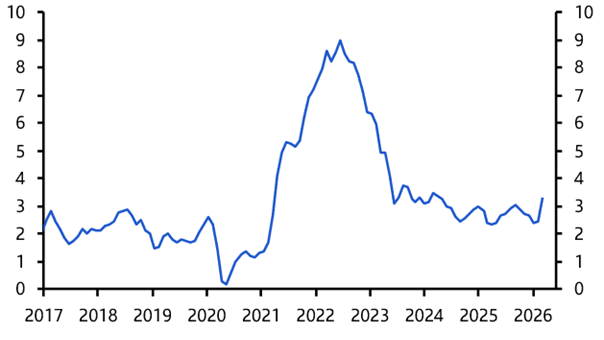
However, there is a danger – particularly in the minds of the public and politicians – of confusing levels with rates of change. What I encountered in New York was not high inflation, which is the rate at which prices change, but a higher price level. One is, of course, the product of the other. But a disconnect between politicians and the public starts to develop when the former claim that inflation has been defeated, while the latter continues to experience prices that feel unusually high. This may help to explain why consumer confidence in the US is unusually depressed even though the economy has performed relatively well. (See Chart 2.)
|
Chart 2: US Consumer Sentiment Index |
|
|
|
Sources: University of Michigan, Capital Economics |
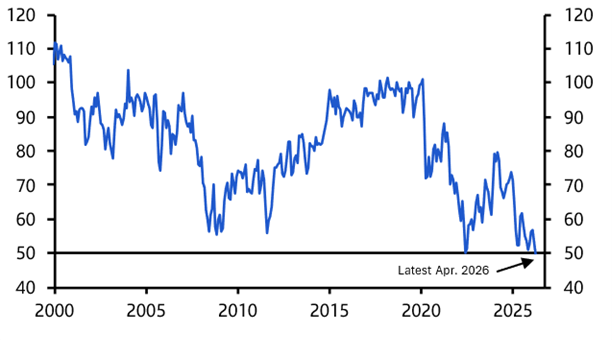
Central to this issue is that prices are sticky on the downside; they rise easily, but – short of outright depression – rarely fall. Of course, this is not true of all goods. The price of fuel, for example, tends to move up and down in line with global energy prices. This is particularly the case in the US where fuel taxes are relatively low and wholesale price movements pass through quickly to the pump. (See Chart 3.)
|
Chart 3: Gasoline Prices ($ per gallon) |
|
|
|
Sources: EIA, LSEG Data & Analytics, Capital Economics |
This has important implications for how we should think about the inflationary consequences of the war in Iran, to which I will return later.
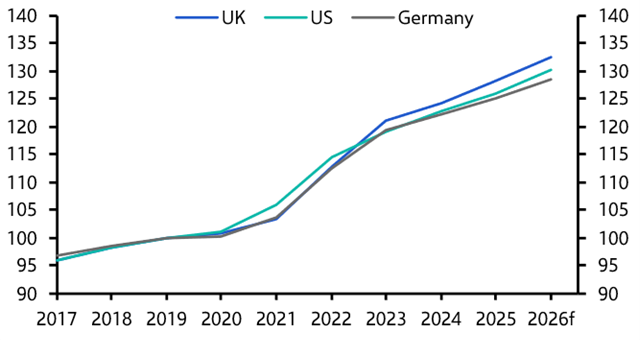
But fuel (and to some extent food) prices are the exceptions. The price of most goods and services exhibit strong downward rigidity. This means that a burst of inflation causes the price level to ratchet higher and then stay there. This is not just true of the US. The level of consumer prices in the US and major economies in Europe is now about 30% above its 2019 level. (See Chart 4.)
|
Chart 4: Consumer Prices Indices (2019 = 100) |
|
|
|
Sources: LSEG Data & Analytics, Capital Economics |
Inflation has fallen across advanced economies, but the damage, if that is the right word, is done. What, then, are the lessons and how do they apply to the situation in which we find ourselves today?
First, the immediate inflationary impact of the war in Iran will come through the energy channel – and, indeed, we are already starting to see this show up in the data. March data showed a sharp uptick in inflation across the US, euro-zone and the UK, driven largely by fuel. Crucially, however, the moves in core inflation remained more muted and in the case of the euro-zone and the UK actually fell. This is important because the critical issue for central banks is the breadth and persistence of the inflation shock. A short-lived spike in energy prices can be “looked through”; a prolonged inflation shock that spreads across all goods and services risks embedding itself in expectations and wage-setting behaviour, creating so-called “second-round effects”.
In this regard, the state of the labour market is key. As the Fed’s inflation guru, Jeremy Rudd, has argued, a rise in inflation expectations is more likely to result in faster wage growth (and thus second-round inflation effects) when labour markets are tight. That was true in the immediate post-pandemic period; it is less obviously so today. If the current conflict is resolved in the coming weeks and, more importantly, the Strait of Hormuz is reopened, central banks may be less inclined to respond aggressively than they did earlier this decade. The risk that the price level increases to the same extent that it did earlier in this decade is lower.
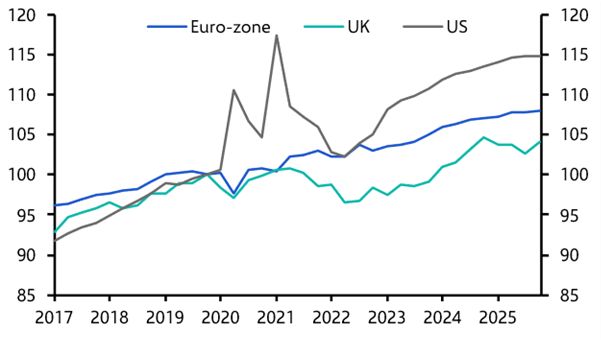
A second key point is that inflation creates winners and losers. For households, the key question is whether incomes keep pace with prices. In the US, despite the collapse in consumer confidence, real incomes have actually increased by a relatively healthy amount in recent years. Household real incomes are now about 15% higher than at the start of 2020. In contrast, while real incomes in Europe also increased over this period, their rise has been far smaller. (See Chart 5.) This is partly because productivity growth in the euro-zone and UK has been weaker, which in turn has weighed on real income growth. But it is also the case that – as a large net energy importer – the energy shock created by Russia’s invasion of Ukraine in 2022 led to a significant deterioration in the region’s terms of trade, which in turn manifested itself in downward pressure on real incomes.
|
Chart 5: Real Household Disposable Incomes |
|
|
|
Sources: LSEG Data & Analytics, Capital Economics |
Something similar is likely to play out as the economic fallout from the war in Iran unfolds. The burden of higher energy prices will fall most heavily on net energy importers, namely Europe and much of Asia. In contrast, the US is relatively insulated by virtue of the fact that it is now a small net energy exporter. This doesn’t mean that US consumers will be entirely immune from the effect of higher prices. But relative to their counterparts in other countries the hit is likely to be smaller and the US economy as a whole will suffer less.
The overall scale of the economic damage will, of course, depend on the extent of the disruption to energy supplies and the degree to which prices rise. As things stand, the disruption to European energy markets has been much smaller than was the case in 2022. But regardless of how the war develops, one consequence is likely to be that it will reinforce the recent outperformance of the US economy over its developed market peers.
In case you missed it
- With no sign of a near-term resolution to the US-Iran stand-off in the Strait of Hormuz, our online Drop-In briefing on Wednesday 0900 ET/1400 BST will address the risks around an adverse conflict scenario and its implications for the global economy. Register here.
- Chief Global Economist Jennifer McKeown covered off some of the more frequent questions from clients about how central banks are calibrating policy in this conflict.