

The Iran conflict is more than just another shock to the global economy; it’s a reminder that the long-neglected supply side is becoming an increasingly potent source of macroeconomic instability.
Policymakers and investors have focused overwhelmingly on the demand side of the economy for much of the past four decades. During this time, recessions were typically the outcome of shortfalls in aggregate demand – the result of financial crises, policy tightening or cyclical downturns. The playbook was accordingly well-rehearsed: ease monetary policy and boost fiscal support to stimulate demand and, in time, output would recover. The Global Financial Crisis is the clearest example of this at work. Earlier episodes – recessions in the US in 2001 and in the UK in the early 1990s – fit a similar, if less extreme, pattern of demand-driven weakness.
In all of this, the supply side was largely ignored. Recessions caused by weaker demand created spare capacity as firms shed workers and mothballed capital. This created latent supply that could be drawn upon to increase output as demand recovered. Most thinking about the supply-side was instead focused on creating the conditions for the most efficient allocation of resources. Globalisation, deregulation and technological integration created a system that was lean, interconnected and highly productive. The expansion of global supply chains delivered gains in efficiency and helped lift hundreds of millions out of poverty. But this same system also created hidden vulnerabilities – chokepoints that are now becoming increasingly visible.
Chokepoints emerge
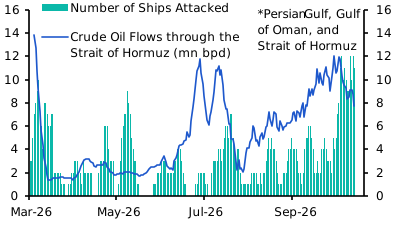
Over the past six years, those vulnerabilities have been repeatedly exposed. The pandemic was the most dramatic example: a non-economic shock that triggered severe disruptions across global supply chains, constraining production even as demand was supported by unprecedented policy stimulus. The result was the sharpest inflation surge in decades. Russia’s invasion of Ukraine in 2022 delivered a further blow, particularly through energy markets in Europe. Disruptions to shipping routes – most notably in the Red Sea in 2023 – added another layer of strain. Trade policy has also become more erratic, with tariffs and industrial policies increasingly shaped by geopolitical rather than purely economic considerations. And now, the closure of the Strait of Hormuz, through which flows roughly one-quarter of the world’s seaborne oil and a fifth of its natural gas, has exposed another critical chokepoint in the global economy.
Underpinning all of this is a deepening superpower rivalry between the United States and China. As highlighted in our work on global fracturing (and my book, The Fractured Age), the global economy is moving away from a model of integration toward one defined by fragmentation, security concerns and competing blocs. The result is that efficiency is no longer the sole organising principle; resilience and control are increasingly taking precedence. Supply chains are being reconfigured accordingly.
Counting the economic costs
We are only beginning to understand the full economic consequences of this shift. For growth, it is important to distinguish between the short- and longer-term effects of supply disruptions. In the near term, these shocks can be highly uneven: from the immediacy and severity of the pandemic to the relatively modest impact of disruption to Red Sea shipping in 2023. What matters most is the scale of the shock, its breadth across sectors, and the extent to which it affects critical inputs that are difficult to substitute quickly – as illustrated by Europe’s exposed reliance on Russian natural gas in 2022. Shocks that are both large and either broad-based or concentrated in essential inputs tend to be the most damaging.
Over the longer term, the effects are more ambiguous. Heightened uncertainty about supply conditions, trade relationships and policy frameworks is likely, all else equal, to weigh on investment, as firms become more cautious about committing capital in an environment where the assumptions underpinning future returns are less secure. In some cases, large shocks can leave persistent scars, particularly in labour markets. However, there is a risk of overstating these costs. While the deepening integration of global supply chains in the 1990s and 2000s did support productivity growth, the magnitude of these gains was probably modest. By extension, a partial reversal of that integration is unlikely to impose large costs on potential growth.
Moreover, recent experience suggests that supply chains are more adaptable than often assumed. Firms adjust, production is re-routed, and new suppliers emerge over time. The experience of the past decade suggests that the pace of change matters. When reconfiguration is gradual, costs can be contained. In the years after the Fukushima disaster in 2011, Toyota gradually but systematically removed single points of failure in its supply chain with little measurable impact on costs.
Most importantly, the dominant driver of long-term growth remains technological progress. Even in a more fragmented and disruption-prone global economy, there is little reason to think that this fundamental engine of growth will be materially impaired.
The implications for inflation are more subtle than is often assumed. Supply shocks naturally push prices higher in the short term, particularly in energy and commodities. But these effects are not necessarily persistent. As supply recovers, or as high prices incentivise new production and dampen demand, prices can fall back – and sometimes sharply. Indeed, the experience of oil markets following the Ukraine invasion illustrates this dynamic: while prices rose sharply in the six months following Russia’s invasion they then peaked and fell steadily over the subsequent year, such that 18 months later they were below pre-war levels. The result is not simply higher inflation, but more volatile inflation, an environment that is inherently more challenging for policymakers.
Meeting the policy challenges
For central banks, this represents a fundamental shift. Their tools are designed primarily to manage demand, not supply. In a world of more frequent supply shocks, maintaining price stability becomes more challenging. The key task is making sure inflation expectations remain anchored. If temporary price increases feed into wage-setting and broader price dynamics, inflation can become entrenched. Preventing this may require tighter monetary policy, even in the face of weak growth. This argues against calls for central banks to take on multiple objectives, from supporting productivity to addressing climate risks. In a more volatile supply environment, monetary policy should refocus on a single, clear mandate: price stability. As anchoring expectations becomes harder, credibility will be critical.
The challenge is arguably even greater for governments. The long-standing view that supply-side efficiencies must be prioritised is no longer sufficient. Resilience must now play a central role. This means identifying critical vulnerabilities in the economy – whether in energy, technology or supply chains – and developing strategies to mitigate them. It also requires closer collaboration with the private sector, which will ultimately drive much of the necessary adjustment.
There are significant fiscal implications. Building resilience – whether through infrastructure, diversification, or strategic stockpiling – comes at a cost. At the same time, governments need the capacity to respond to shocks when they occur. This will require more fiscal space, as well as a reassessment of spending priorities. Defence spending, in particular, is likely to rise as geopolitical tensions intensify.
All of this suggests that we are entering a new economic era – one in which supply-side dynamics play an increasingly important role in shaping outcomes. The transition from a globalised system to one that is more fragmented is unlikely to be smooth. But recognising the nature of the shift is the first step toward managing it.