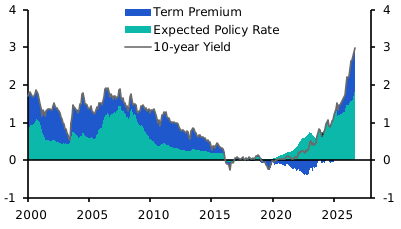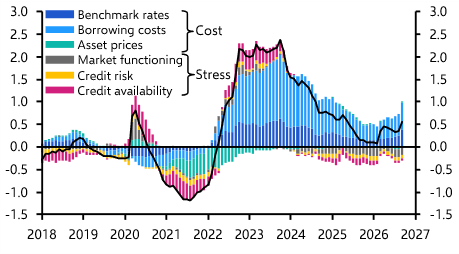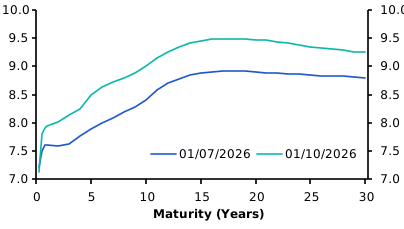
Two themes have dominated markets over the past few weeks: the sustainability of the AI investment boom, particularly the debt financing behind it, and the sell-off in bond markets, which at one point earlier this month pushed 10-year US Treasury yields to their highest level since the mid-2000s.
We will return to the AI capex boom in a forthcoming piece. For now, while we remain optimistic about AI’s potential to boost productivity, it is becoming harder to see how the returns generated will justify the scale of the investment surge over the past year. That judgement is necessarily uncertain, however, given the difficulty of assessing the technology’s future revenue potential.
The outlook for bond yields is more clearly a macroeconomic question. What matters most is the outlook for inflation and, in turn, monetary policy. On this front, the latest data – including hotter-than-expected US inflation figures for September – have been troubling. But, as we set out in our latest Global Inflation Watch, while inflation is likely to rise further in the near term, we expect it to fall back in 2027.
Still mainly an energy issue
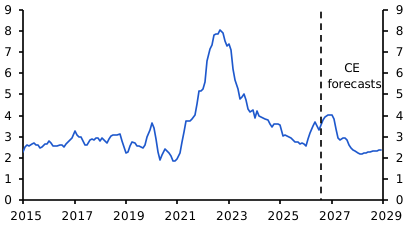
Global inflation rose from 2.6% y/y in January to 3.6% y/y in August (the latest month for which we have full data). (See Chart 1.)
Chart 1: Global CPI Inflation (% y/y) |
 |
Sources: LSEG Data & Analytics, Capital Economics |
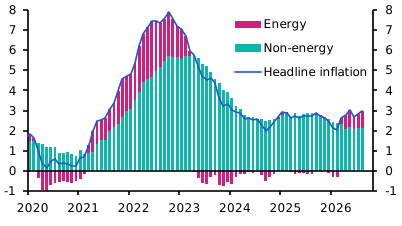
But this increase has been driven almost entirely by higher energy prices. In advanced economies, non-energy inflation was actually marginally lower in August than before the Iran war began. (See Chart 2.)
Chart 2: Contributions to DM Headline Inflation (% y/y) |
 |
Sources: LSEG Data & Analytics, Capital Economics |
Energy prices will continue to push up headline inflation in the months ahead. We forecast that Brent crude will remain around $100pb into early 2027 and, just as importantly, expect refining margins to stay elevated. This will push up fuel inflation, although price caps should limit the impact in Japan and parts of Asia. Higher natural gas prices will also raise household energy inflation across most advanced economies, although not in North America, where gas prices and power generation costs have barely risen this year. Taken together, these pressures are likely to push global inflation to above 4% y/y in early 2027.
The outlook beyond that will depend to a significant extent on what happens to global energy prices and, by extension, supplies from the Middle East. Our baseline forecasts assume that Middle East supply gradually improves over the first half of next year, causing Brent crude to fall to $70pb by the end of 2027 and European natural gas prices to decline to €40/MWh. This should bring down both fuel and household energy inflation.
There will also be indirect effects. Higher energy costs will feed through into food prices and other energy-intensive goods and services, pushing food inflation to multi-year highs in most developed economies. But these effects should slow, rather than prevent, the decline in headline inflation as energy prices fall.
Second-round effects still absent
The more important question for central banks is whether the energy shock generates second-round effects. The concern is that households and firms respond to higher prices by demanding higher wages and raising their own prices, turning a temporary inflation shock into a more persistent domestic problem.
We think this risk is relatively low. Although household inflation expectations have risen, economic conditions are very different from those that prevailed during the last energy-driven inflation shock in 2022. Labour markets are less tight, limiting workers’ ability to secure compensatory pay rises. Firms also generally report that demand is not as strong, thus restricting their ability to pass higher costs on to consumers. We therefore doubt that higher inflation expectations will translate into a sustained acceleration in wage growth. This should, in turn, limit both the rise in core inflation and the time it remains elevated.
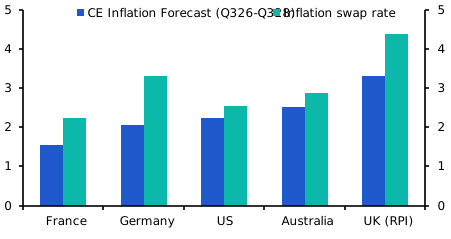
Inflation dynamics will, of course, differ by country. We expect underlying price pressures to remain stronger in the US, partly because of the effect of the AI boom on consumer technology prices. But we expect core inflation to remain below 3% in the major developed economies and fall towards 2% by the end of 2027. Our forecasts for headline inflation are also below the rates implied by inflation swaps over the next two years and, in most cases, below consensus expectations for 2028. (See Chart 3.) The gap is particularly pronounced in China, where we expect the deflationary forces associated with excess capacity to reassert themselves.
Chart 3: Capital Economics Inflation Forecast & 2-year Inflation Swap Rate (%) |
 |
Sources: LSEG Data & Analytics, Capital Economics |
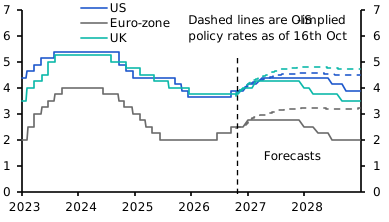
This brings us back to monetary policy and bond yields. If inflation falls as we expect, central banks will not need to raise interest rates as far as markets currently anticipate. We expect the Fed, ECB and Bank of England to tighten policy over the coming months, but by less than markets are pricing in. (See Chart 4.)
Chart 4: Policy Interest Rates (%) |
 |
Sources: LSEG Data & Analytics, Capital Economics |
To be fair, the risks to this outlook are skewed in one direction: a deeper or more prolonged disruption to energy supplies from the Gulf would push inflation higher and could force central banks to tighten policy more aggressively. But absent such a development, the recent rise in bond yields looks difficult to justify on the inflation outlook alone.
In case you missed it
Stephen Brown argues that AI-related activity has accounted for just over one quarter of US GDP growth over the past year.
This week we are hosting events on everything from Israel’s elections to the outlook for commercial real estate. Sign up here.
We are delighted to partner with Fathom Consulting to launch China Scenarios – a quarterly scenarios service for China’s economy. To receive this on a complimentary basis, click here.