Global government bond markets have come under renewed pressure in recent weeks, with yields on thirty-year bonds touching their highest levels since 2007 in several major economies.
This is not yet a bond market crisis. But there are good reasons why investors should demand higher returns for holding long-dated government debt than they did in the years before the pandemic.
Unpacking the sell-off
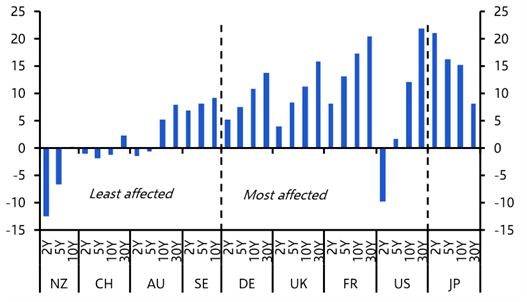
It is perhaps no surprise that the largest increases in bond yields have occurred in economies where fiscal risks are greatest: the US, UK, France and Italy. In most cases, the rise has been concentrated at the long end of the yield curve, with shorter-dated yields – which are more closely tied to expectations for central-bank policy rates – rising by less. (See Chart 1.) Japan is the exception, with yields on its government bonds rising across the curve as markets price higher policy rates.
But Japan aside, the rise in yields is less about expectations of higher policy rates than a growing reluctance to hold long-dated government debt without greater compensation.
|
Chart 1: Changes in Gov’t Bond Yields since 28th July (bp) |
|
|
|
Sources: LSEG Data & Analytics, Capital Economics |
There are several reasons for this. Fiscal positions have deteriorated materially across much of the developed world. Government debt is high, deficits remain large and there is little political appetite for the consolidation needed to put public finances on a clearly sustainable path. (Japan is once again an exception in this regard.) The inflation environment is also more uncertain than it was during the 2010s, while the Iran war is another reminder that the world is more prone to geopolitical shocks, and that these shocks are inherently stagflationary. And uncertainty around monetary policy has increased. While much of the focus has been on new Federal Reserve Chair Kevin Warsh’s push to reduce “forward guidance”, the bigger issue is that his muddled communications have left markets less certain about the Fed’s policy framework.
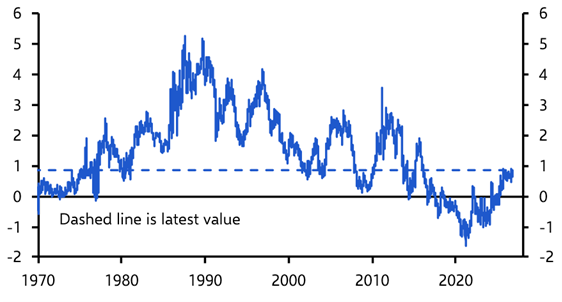
The yields of bonds reflect expectations for short-term interest rates over time and term premia, which reflect the additional compensation that investors demand for holding them. The key point is that most of the recent increase in bond yields seems to have been driven by the latter. (See Chart 2.)
|
Chart 2: Estimate Of 10-yr US Treasury Term Premium |
|
|
|
Sources: LSEG Data & Analytics, Capital Economics |
A permanent shift
It is striking that there has been no obvious economic or market trigger for the latest bond sell-off. Energy prices have risen, but nowhere near as sharply as during the earlier stages of the Iran conflict. Fiscal positions remain strained, but have not suddenly deteriorated. And structural changes in the investor base for government bonds are gradual rather than sudden.
However, even if yields fall back, it would be a mistake to assume that they will simply return to their previous levels. The exceptionally low term premia between the Global Financial Crisis and the COVID pandemic reflected an unusual combination of weak growth, persistent disinflationary pressures and extraordinarily accommodative monetary policy, including large-scale bond purchases by central banks.
Conditions have now changed. In some ways this reflects a return to economic normality: deflation is no longer the biggest threat, unemployment has fallen and central-bank balance sheets have shrunk. But governments are issuing substantially more debt, inflation risks have increased and pension funds and insurers are less important marginal buyers of long-duration government debt. Taken together, it would be surprising if investors were willing to hold long-dated government debt at the same historically low term premia as before.
Economic consequences are manageable – so far
The economic consequences should be manageable, at least for now. The sell-off has been concentrated at the very long end of yield curves, which have relatively little influence on household and corporate borrowing costs. Ten-year yields matter considerably more. And although higher government bond yields eventually feed through into private-sector financing costs, there has so far been little evidence of the broader tightening in financial conditions that would turn the bond market adjustment into a significant macroeconomic shock.
Corporate bond spreads remain tight and measures of bond-market volatility have risen, but not to the levels seen during the major dislocations of 2022 and 2023.
|
Chart 3: US Investment Grade Credit Spreads & Option-Implied Treasury Market Volatility |
|
|
|
Sources: LSEG Data & Analytics, Capital Economics |
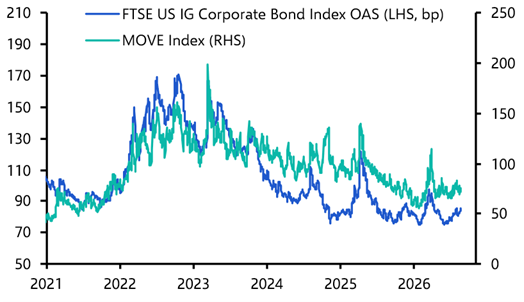
The danger is that the repricing becomes disorderly, generating losses for leveraged investors and forcing them to sell assets into a falling market. That was the dynamic behind the UK gilt crisis in 2022. A similar episode would cause a sudden tightening in financial conditions and would pose a much bigger risk to economic activity – but we’re not there yet.
How should policymakers respond? The recent rise in yields should not necessarily be treated as a problem. To some extent, it is the market doing exactly what it is supposed to do: pricing risk. As noted earlier, higher yields are also, in some respects, a return to normality after the ultra-low yields and exceptionally loose monetary policy of the 2010s.
Central banks will only become concerned if a rapid sell-off threatens financial stability. If that happens, there is a strong case for intervention, as the Bank of England demonstrated in 2022 when it temporarily bought long-dated gilts to prevent a forced-selling spiral. But that was a response to a financial-stability threat. If yields are rising because investors are demanding more compensation for fiscal and inflation risks, central banks should not try to suppress the move.
At root, this is a fiscal issue. Governments can ease pressure at the margin by adjusting the composition of debt issuance. Japan has already reduced the supply of very long-dated bonds, while the US has increased its reliance on Treasury bills. The announcement last week that the US Treasury will double the size of its buyback operations at the 10 to 30-year part of the curve works in a similar way. These moves send a signal to markets, but the sums involved are small.
More fundamentally, debt management is not a substitute for fiscal consolidation. This helps to explain why the Treasury’s expanded buyback announcement provided only temporary reprieve to the bond market.
Governments with unsustainable fiscal trajectories will ultimately need to put them on a more sustainable path. The largest adjustments are required in the US, France and the UK (our key analysis on fiscal challenges can be found here). Given the limited political appetite for doing so, particularly in the US, bond markets are likely to remain vulnerable to further bouts of volatility.
The bond market is therefore sending a rational message: the world is riskier, government debt burdens are higher, inflation risks are less predictable and the political willingness to address fiscal problems is limited. Some of the recent rise in yields may unwind. But the old world is gone, and these underlying forces mean upward pressure on term premia is likely to be a lasting feature of the post-pandemic age.
In case you missed it
The White House is calling it the ‘Great Transhipment Scam’, but Leah Fahy draws on our data and analysis to show how any crackdown on illegal Chinese exports would have only a small impact on flows in aggregate.
Collapsing exports of models with internal combustion engines has pushed the euro-zone’s trade balance in cars into a deep deficit, pointing to further declines in production ahead.
Harry Chambers laid out the case for the Swiss franc to strengthen against the euro next year.