
If last week’s press appearance was meant to be a demonstration of Kevin Warsh’s intent on scaling back the Federal Reserve’s communications and the role of policymakers in shaping market expectations, it was an unedifying one.
The Chairman’s muddles
Among the many muddles that the new Fed chair introduced into the US policy debate was his argument that the rise in nominal and real long-dated Treasury yields since June reflected the fact that investors were “learning to play the ball, not the referee” – in other words, responding to economic data (the ball) rather than trying to anticipate the Fed (the referee).
The analogy is fundamentally misplaced. The Fed is not a referee interpreting the rules of the game; it sets one of the game’s most important rules by determining short-term interest rates. Warsh went on to say that “central banks need not always and everywhere be the centre of attention”. But once again this seems to misunderstand the role of the Fed. The markets are trying to price how the Fed will set short-term interest rates. The incoming data only matter because they influence the Fed’s response. The central bank is, by design, the centre of attention.
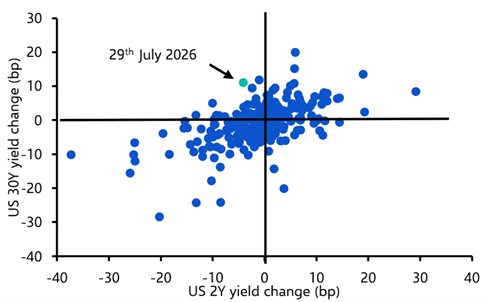
Markets understandably struggled to reconcile the mixed messages. Investors pared back expectations for near-term rate hikes and sold off longer-dated bonds, pricing a less hawkish Fed in the short run but greater inflation risks over the longer term.
That relatively unusual response to an FOMC meeting was not a great outcome for a Fed chair that has spent the past month trying to assert his inflation-fighting credentials. (See Chart.)
|
Chart 1: Changes In 2-yr and 30-yr Treasury Yields On FOMC Announcement Days Since 1994 (bp) |
|
|
|
Sources: LSEG, Capital Economics |
The many forms of forward guidance
Beyond his muddled messaging, Warsh’s broader push to scale back communications is worth unpacking. At the heart of his approach to reforming communications is a long-running debate over how much forward guidance central banks should provide.
Forward guidance exists on a spectrum. At one end, policymakers seek to influence market expectations for future interest rates – and therefore financial conditions – by signalling how they expect policy to evolve over coming months. At the other end lies a much stronger form of guidance, where central banks explicitly commit not to adjust policy until specified economic conditions have been met.
The latter approach was adopted by the Bank of England in 2013, when it pledged not to raise interest rates above the ultra-accommodative level of 0.5% until the unemployment rate fell to 7%. The intention was that markets could be confident that policy would remain highly accommodative until labour market conditions had improved sufficiently. In practice, however, neither form of forward guidance is quite as effective as either its supporters or its critics suggest.
Maradona revisited
The lighter-touch version has much in common with what former Bank of England Governor Mervyn King famously described as the “Maradona theory” of central banking. The analogy came from Diego Maradona’s extraordinary goal against England at the 1986 World Cup. (Not that one, this one.) Maradona ran almost directly towards goal but constantly shifted his body, convincing defenders he was about to change direction. They moved out of his way, even though he barely altered his course.
The idea is that central banks can sometimes achieve the desired tightening or loosening in financial conditions simply by shaping expectations, without actually changing interest rates. But there are limits to this strategy. Markets eventually test central banks’ resolve. If policymakers repeatedly hint that rates will rise but fail to deliver, investors will begin to doubt their commitment. Inflation expectations may drift higher and currencies may weaken, forcing policymakers to act anyway. The same logic applies in reverse: if central banks continually signal easier policy but fail to deliver, markets will eventually stop believing them, forcing them to act.
Goodhart’s trap
Nor is stronger forward guidance without its problems. The Bank of England’s experience illustrates why. Its decision to make interest rate hikes conditional on a fall in the unemployment rate was ultimately undermined by structural changes in the labour market, which caused unemployment to fall without generating the wage pressures and inflation that policymakers had expected. In the end, markets started to put less weight on the unemployment data and more on wage and inflation data – thereby continuing to price in ongoing ultra-loose monetary policy, even as the unemployment rate fell. This is a classic example of Goodhart’s Law: once a particular measure becomes the target of policy, it stops being a reliable measure
Fewer meetings, same challenge
Since that press conference, the debate over central bank communication looks set to broaden. According to media reports, Warsh is considering reducing the number of scheduled FOMC meetings held each year, from the current eight to perhaps six.
There is nothing sacrosanct about the current eight annual meetings. By law, the FOMC need only meet four times a year, and the number of meetings has varied considerably over time before settling at the current schedule under Paul Volcker. Even if the Fed moved to six meetings a year, it would still convene more often than the quarterly Swiss National Bank but less frequently than the ECB or the Bank of England, both of which meet eight times a year. Indeed, the Bank of England cut the number of its policy meetings from 12 following a recommendation in Kevin Warsh's 2014 review of its operations.
Within reason, the number of policy meetings held annually is less important than it might first appear. Fewer meetings do not necessarily lead to better policymaking. The argument in favour of reducing their frequency is that policymakers are less tempted to tinker with policy, resulting in a more stable approach. The trade-off, however, is that they may be slower to respond to unexpected shocks or rapidly changing economic conditions. While emergency meetings remain an option, they can have a much greater impact on markets, creating the impression that policymakers know something investors do not.
In isolation, fewer annual meetings would be unlikely to have major implications for the conduct of monetary policy. But nor would they necessarily lead to more stable or higher-quality decision-making. The bigger concern is the backdrop against which this change is being considered. If the Fed communicates less frequently, each meeting carries greater weight. That, in turn, makes clear and consistent communication even more important.
Judging by the confusion surrounding last week’s communications, that is not a standard the Fed under its new chairman is currently meeting.
In case you missed it
For all the noise surrounding Warsh's communications, recent US data point to stronger underlying demand and persistent inflation pressures, meaning a September rate hike remains more likely than not.
The latest update of our EM Financial Risk Indicators show economies generally weathering the Middle East conflict, though higher energy prices are leaving some exposed. Our Drop-In briefing on this update is this Wednesday.
Following last week’s Drop-In on China’s progress in AI, the team focused on the implications of news of advances in Chinese chipmaking.