The cacophony surrounding a recent US-Japan intervention to shore up the yen has focused largely on what it says about the international monetary system. Less attention has been paid to the domestic economic conditions that weakened the currency so much in the first place. But understanding that backdrop not only helps explain why intervention became necessary, but also offers lessons for policymakers well beyond Japan.
Macro fundamentals don’t explain pressure on the yen
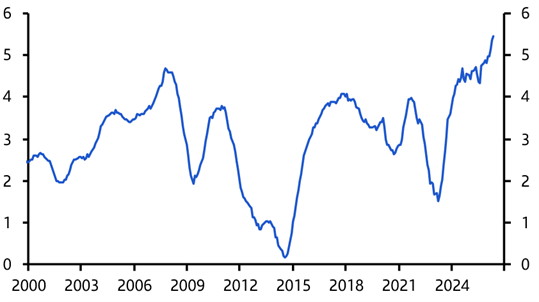
From a macroeconomic perspective, there is little to justify a weak yen. Japan runs a current account surplus that has actually increased in recent years and is now equivalent to more than 5% of GDP. (See Chart 1.) This is despite the fact that the economy is running at close to full employment. The combination of a large current account surplus run by an economy at full employment would ordinarily be associated with the need for a stronger, rather than a weaker, currency. Likewise, Japan's real effective exchange rate remains well below its long-run average. Our models suggest that the yen's fair value against the dollar lies in the ¥125-130 range, compared with around ¥163 when the US and Japan intervened and ¥158 at the time of writing.
|
Chart 1: Japan Current Account Balance (% of GDP) |
|
|
|
Sources: LSEG Data & Analytics, Capital Economics |
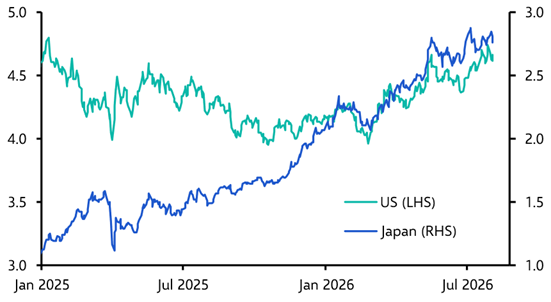
Nor do differences in US and Japanese interest rate levels provide a convincing explanation. Admittedly, the rise in US Treasury yields in recent months has probably put some downward pressure on the yen. But Japanese government bond yields have also increased. Indeed, yield differentials have moved marginally in the yen's favour over the past year rather than against it. (See Chart 2).
|
Chart 2: 10-year Government Bond Yields (%) |
|
|
|
Sources: LSEG Data & Analytics, Capital Economics |
Signs of indiscipline
If neither macroeconomic fundamentals nor interest rate differentials explain a weak yen, what does? The answer may lie in shifting perceptions of Japan's policy outlook.
There are legitimate reasons for markets to be concerned. Prime Minister Sanae Takaichi's government is pursuing what it has called “responsible proactive fiscal policy”. But, as our Head of Asia-Pacific Economics, Marcel Thielian, argued last week, the latest “Basic Policy on Economic and Fiscal Management and Reform”, an annual government policy blueprint, placed more emphasis on the "proactive" rather than the "responsible" part of this strategy. The government has abolished the gasoline tax surcharge and reintroduced subsidies for gasoline, electricity and natural gas and plans to slash the sales tax on food from 8% to 1% for two years starting next April. The centrepiece of the government’s strategy to reinvigorate economic growth is a major increase in investment spending, although it is expected that some of this will be funded by the private sector.
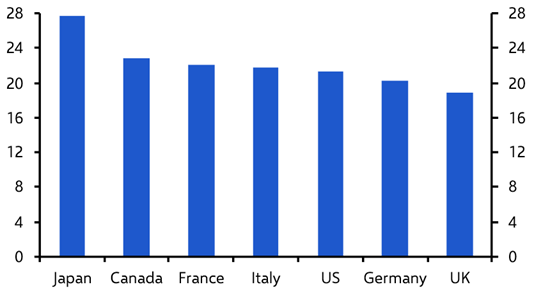
This is a questionable strategy. Unlike economies such as the UK, Japan does not suffer from a low investment rate. (See Chart 3.) It is therefore far from clear that higher public and private investment will materially raise long-run trend growth. More fundamentally, fiscal expansion at a time when the economy is already operating close to full employment is more likely to add to inflation than to output.
|
Chart 3: Investment (% of GDP, 2025) |
|
|
|
Sources: LSEG Data & Analytics, Capital Economics |
To compound matters, there are growing concerns about government pressure on the Bank of Japan. Takaichi has a long-standing preference for looser monetary policy and according to media reports asked Governor Kazuo Ueda in May to step up the BOJ’s Japanese government bond purchases. She has also appointed two “doves” to the Bank’s nine-person board and will have the opportunity to appoint two more board members next year.
All of this creates an uncomfortable backdrop for financial markets. The Bank of Japan estimates that half of the increase in 10-year government bond yields over the past two years has been due to a rise in term premia, consistent with growing investor concerns about the fiscal and inflation outlook. These concerns would also help explain the yen's weakness.
In other words, the unusual combination of rising bond yields and a weaker currency can be interpreted as markets becoming less confident in Japan's fiscal and monetary policy framework.
No fiscal basket case
But have markets gone too far in their concerns? There are important lessons here, and not just for Japan.
Although Takaichi’s government looks set to pursue a looser fiscal policy, the degree of additional support is likely to be relatively small. More importantly, as we have argued for some time, Japan is not the fiscal basket case that it is often made out to be. In fact, the economy is on course to record a primary budget surplus this year and is one of the few G7 members where the debt-to-GDP ratio is falling. At the same time, the domestic savings rate remains exceptionally high. A fiscal crisis in Japan is therefore a distant prospect.
Indeed, we expect the fiscal position to continue improving over the coming years, even allowing for the Takaichi government's spending plans. Likewise, efforts to reshape the BOJ's board are unlikely to produce a meaningful shift in monetary policy any time soon. We continue to expect the Bank of Japan to raise interest rates again in September and ultimately take the policy rate to around 2% next year.
Taken together, this suggests that markets may have become overly pessimistic about the policy trajectory in Japan. This implies that a still significantly undervalued yen could appreciate significantly as and when the more extreme concerns around Japan’s fiscal and monetary outlook prove unfounded.
The real lesson from Japan
There is also a broader lesson for policymakers elsewhere. The gap between market perceptions and underlying fiscal reality in Japan is instructive. The problem is not that Japan is on the verge of a fiscal crisis. Rather, markets have become concerned that the government's rhetoric points to a less disciplined fiscal regime in future.
The lesson is that markets rarely wait for fiscal deterioration to show up in the data. They price future policy risks well in advance. Once confidence begins to erode, countries can find themselves facing the toxic combination of rising government bond yields and a weakening currency. Breaking that cycle often requires a more significant policy reset than would have been needed initially.
Japan is not close to that point. Its high domestic savings rate provides an important buffer that many other advanced economies lack. But countries with lower savings rates and persistent current account deficits – not least the UK – have far less room for manoeuvre. In an era of large fiscal deficits and high public debt burdens, the lesson from Japan is that rhetoric matters almost as much as policy itself.
Governments elsewhere should take notice.
In case you missed it:
The coming week’s US CPI data could prove critical to deciding whether the Fed delivers a September rate hike.
Jack Allen-Reynolds showed where Europe’s unusually hot summer is affecting the economy.
AI will continue driving office demand in the world's leading tech hubs. But what happens when the bubble bursts? Kiran Raichura identifies the global winners and losers amid the technology’s build-out. He will answer questions about the US CRE outlook in an online Drop-In this Wednesday. Register here.