At the start of the Iran war in February there was a natural tendency to look to the last global energy shock, which followed Russia’s invasion of Ukraine in 2022, for a blueprint for what might happen to the global economy. As we noted at the time, this was a poor comparison. Developments since then have borne that out, not least because Europe has proved more resilient than it was four years ago.
Surprising resilience
The data released over the past week illustrate the extent of this resilience. The UK economy grew by 0.4% q/q in the second quarter of this year, following growth of 0.6% in the first. The euro-zone economy also grew at 0.4% in the second quarter. Excluding notoriously volatile Irish GDP data, the euro-zone expanded by 0.3% q/q, matching the pace of the first quarter. The story is of a region that has defied fears of an economic collapse in the face of another global energy shock. Economies across Central and Eastern Europe tell a similar tale of resilience, with Poland’s economy growing by 0.9% q/q in the second quarter.
What’s behind this resilience? It is tempting to argue that Europe is benefiting from a boost to activity from AI. After all, the Information and Communication Technology sector has been a particular source of strength in the UK. But this has less to do with AI than might initially appear, and more to do with an increase in media and marketing activity, some of which may be related to the football World Cup. The balance of evidence is that AI is providing a much smaller boost to GDP in Europe than in the US.
A smaller shock
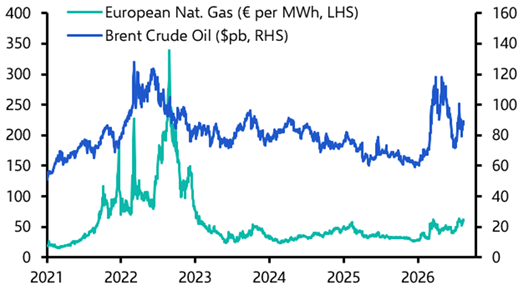
Instead, the relative resilience of the European economy reflects several other factors. The first is that the size of the terms of trade shock has been smaller than many feared. The increase in global energy prices has been more modest than in 2022, particularly for natural gas. (See Chart 1.)
|
Chart 1: Brent Crude Oil and European Natural Gas Prices |
|
|
|
Sources: LSEG, Capital Economics |
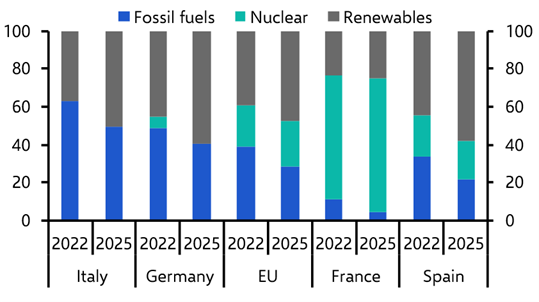
At the same time, Europe has started to reduce its dependence on fossil fuels. Renewables have become a more important source of electricity generation over the past three years. (See Chart 2.) Energy efficiency has also improved. As a result, the euro-zone’s imports of oil by volume have fallen by about 10% compared with 2022, while imports of natural gas have fallen by close to 15%.
|
Chart 2: Electricity Generation by Source (%) |
|
|
|
Sources: Ember, Capital Economics |
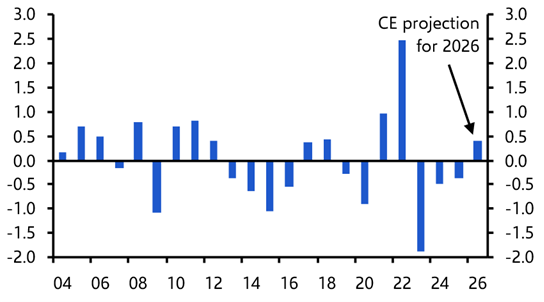
The net effect of all this is that the drag on activity from higher energy prices has been smaller than many assumed. This is seen in Chart 3, which shows the annual change in oil and natural gas imports as a share of euro-zone GDP. The larger the bar above the line, the bigger the drag on euro-zone GDP growth and, as the chart shows, the drag on growth this year has been much smaller than in 2022.
|
Chart 3: Annual Change in EZ Oil & Natural Gas Imports (% of GDP) |
|
|
|
Sources: LSEG, Capital Economics |
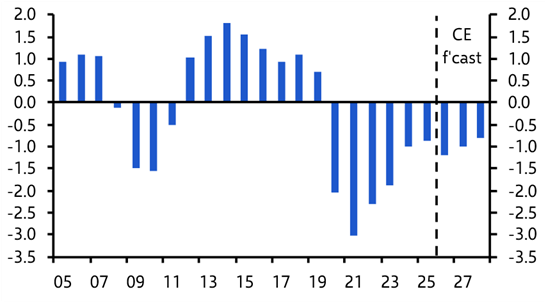
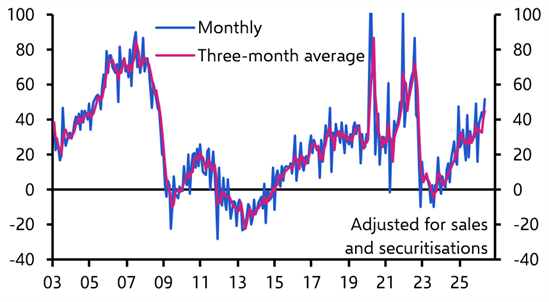
Alongside this, several factors have combined to cushion the impact on activity. Fiscal policy has become more supportive, thanks in part to energy support programmes, but also to higher defence spending and, in some countries, the drawdown of NextGenEU funds. Chart 4 shows an expansion in structural budget deficits across the euro-zone. This has been relatively small, so it will not have provided a huge boost to growth, but it will have helped at the margin. Similarly, bank lending, particularly to companies, has also picked up. (See Chart 5.)
|
Chart 4: EZ Gov’t Primary Structural Budget Balance (% of GDP) |
|
|
|
Sources: LSEG, Capital Economics |
|
Chart 5: Euro-zone Monthly Net Lending to Households & NFCs (€bn) |
|
|
|
Sources: LSEG, Capital Economics |
Households have reduced savings
Two other factors also help to explain Europe’s economic resilience. First, households have reduced their saving rates from the relatively high levels seen at the start of the year. (See Chart 6.) This has helped cushion the impact of higher energy prices on consumer spending. Second, there is some evidence that manufacturers brought forward production in the second quarter to get ahead of perceived increases in energy costs further down the road. The result may have been a build-up in inventories, although this has yet to show up fully in the data.
|
Chart 6: Household Saving Rate (%) |
|
|
|
Sources: LSEG, Capital Economics |
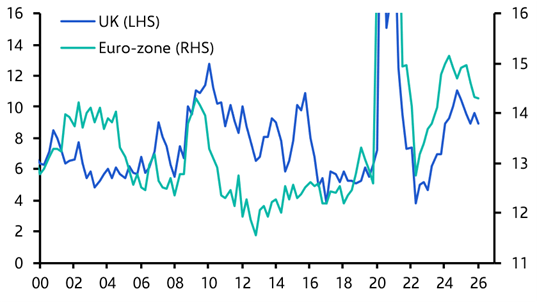
What we do know is that European industry has been resilient, and that this has been particularly true, unusually, of energy-intensive parts of industry. One reason that energy-intensive industry appears to have performed well is that production of refined energy products has been strong. This is probably because widening crack spreads – the difference between crude oil and oil product prices – have boosted producers’ margins.
Muddling through
Accordingly, it appears that a variety of different factors, rather than any single factor, has helped cushion the hit to activity in Europe. And the hit itself has been relatively small by historical standards, at least compared with 2022.
Can this continue? Our view is that the pace of growth in the region will slow over the second half of this year but that the slowdown will be relatively moderate. Inflation has a little further to rise, particularly in the UK, where the pricing of household utilities operates slightly differently and means that higher energy costs feed through with a longer lag. This will add to the squeeze on households, making the outlook for consumer spending slightly worse than it otherwise would have been. At the same time, uncertainty over potential tax rises in the UK Budget in October may weigh on consumer spending.
On balance, though, this is likely to result in softer growth rather than anything worse. We expect the UK economy to grow by about 0.2% q/q in both Q3 and Q4, with the euro-zone growing a little faster, at around 0.25% q/q in both quarters.
None of this is to say that the risks have disappeared. A larger surge in global energy prices caused by the Iran conflict would still pose a significant threat to growth. Nor does it diminish some of the more fundamental challenges facing Europe. Productivity growth remains weak. The boost from AI so far has been much smaller – and is likely to remain smaller – than in the US. And China poses an increasingly significant threat to European industry as Chinese firms move further up the value chain. We will have more to say on this in the coming weeks.
For now, though, Europe’s resilience is a reminder that economies are fluid systems. They adapt to shocks, sometimes in ways that are difficult to predict. And in a region that’s been short of good news in recent years, that’s something to be celebrated.
In case you missed it
We still expect the Fed's next move to be a rate increase, though recent evidence suggests that hike is more likely in December, with a follow-up in early 2027.
Ructions in private credit and AI financing are fuelling concerns about corporate debt, but Simon MacAdam’s analysis shows how finances remain relatively healthy across advanced economies.
Although the PBOC doesn’t seem too concerned about slowing credit activity, we continue to expect 30bp of rate cuts over the coming year because we think deflation will persist for longer than most expect.