Perhaps the most striking takeaway from the Trump-Xi summit in Washington last week is just how low expectations have fallen on both sides.
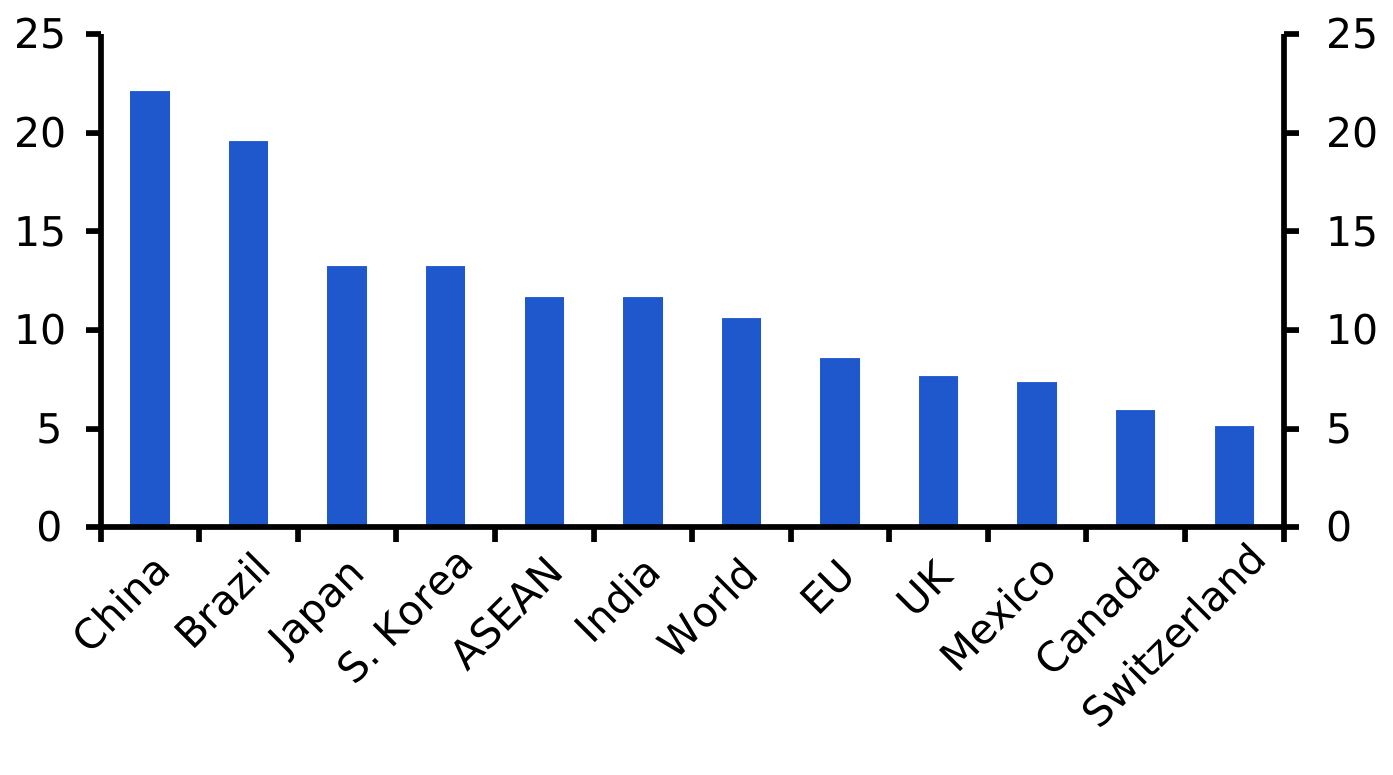
One of the few concrete outcomes was the news that both countries had agreed to reduce tariffs on $60bn of goods trade and to extend the broader trade truce that was agreed last year to January 2027. Both sides spun this as a success, and any steps to reduce trade tensions between the world’s two largest economies are clearly positive. Yet it is worth keeping in mind that the $60bn of goods on which tariffs will be reduced account for just 10% of total bilateral trade, and on the US side could be more than offset by tariff increases if the proposed section 301 tariffs to counter Chinese overcapacity go ahead. The key point remains that the average US tariff on China is still much higher than that imposed on any other major economy – including traditional US allies such as Canada, towards which President Trump has adopted a more adversarial tone in recent months. (See Chart 1.)
Chart 1: Latest US Weighted Average Tariff Rates (%, 2024 Weights) |
 |
Sources: White House, Federal Register, USITC, Capital Economics |
At the same time, reports that Beijing was seeking a longer extension, potentially to the end of Trump’s current term in office are instructive. They suggest that China feels increasingly able to manage the effects of US tariffs on its economy. This in turn reflects its growing export competitiveness, which is a central theme of our series on China Shock 2.0 that clients can find here.
The other area of discussion between the two sides was AI, and in particular its regulation. I say “discussion” but there appears to have been little to discuss. Neither side seems to recognise much need, or urgency, to slow the pace of development or impose meaningful constraints on the technology.
This was a recurring theme at client events we held on the macro and market impact of AI in North America last week. It also comes against a backdrop of warnings from employees at leading AI labs, including senior figures at Anthropic, about the potential destructive consequences of AI if development continues at its current rapid pace.
As economists, this takes us somewhat outside our comfort zone. Our primary job is to analyse the impact of new technologies on the macroeconomy – including productivity, employment, inflation and interest rates. We are not well placed to judge the technology itself, or its potential capacity to cause harm. It is also worth noting that some AI experts are more sanguine about the risks. But there is something economics can tell us about how technologies are regulated, and the conditions under which regulation is likely to emerge.
The key point is that AI regulation is a collective action problem. AI will spread across borders, meaning that there is little any single country can do to regulate or control its development short of banning it altogether – an option that would itself be impractical and costly. Instead, effective regulation requires countries to work together to determine how the technology should be governed and where boundaries should be set.
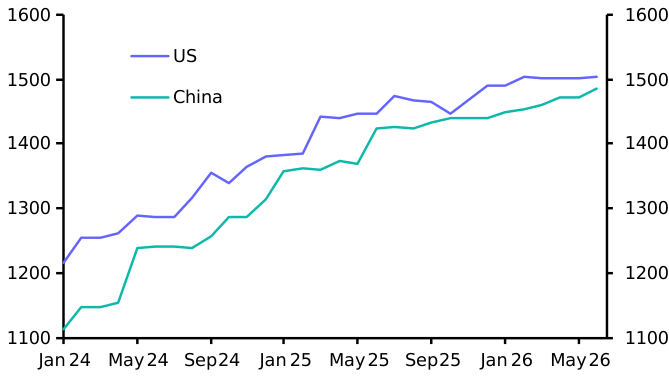
The problem is that AI regulation is no longer simply an economic or political issue. Increasingly, it is a geopolitical one. The US and China are leading the development of AI but are also increasingly locked in a strategic rivalry, with both seeking to establish a lead in key technologies. The US retains an advantage in the most advanced large language models, but China has made rapid progress and narrowed that gap. (See Chart 2.) More importantly, Chinese firms have shown an ability to diffuse increasingly capable models at low cost and at scale.
Chart 2: Performance of Top Large Language Models* |
 |
Sources: Stanford AI Index 2025 Annual Report, Internet Archive, OpenLM AI, Capital Economics. *Chatbot Arena Elo points |
Neither Beijing nor Washington has much incentive to slow the pace of development. Both see leadership in AI as a potential source of strategic advantage, and neither wants to risk ceding that lead to its rival. President Trump has said as much in recent posts on Truth Social.
This creates an uncomfortable dynamic. The geopolitical rivalry between the US and China is not only accelerating the development of AI; it may also be reducing the incentives for either side to support efforts to regulate it. Economists may not be well placed to judge how great the risks posed by AI ultimately are. But the economics of regulation – and the incentives facing the two countries at the technological frontier – suggest that we should at least hope that those sounding the alarm are wrong.
In case you missed it
David Oxely argues that a US export ban would exacerbate rather than alleviate the current diesel crisis.
Ariane Curtis unpacks how a US fiscal crisis could play out.
Our China Shock 2.0 series continues - follow all the analysis here and sign up for events in London, Singapore and Hong Kong here.