The Iran war has presented central banks with a familiar problem. Higher oil prices amount to a classic stagflationary supply shock: they push inflation up while weighing on growth, particularly in energy-importing economies. There is no obvious monetary policy response.
The European Central Bank set the tone last week with what has become the textbook monetary policy reaction to the current crisis. Policymakers acknowledged the inflation risks, reiterated the need to guard against second-round effects on wages and prices, but left policy unchanged. The Federal Reserve and the Bank of England are likely to follow the same playbook at their meetings this week. We expect no change in interest rates from either.
Energy prices not the inflation threat they were
Central banks are well equipped to deal with demand shocks by tightening or loosening monetary policy as required. Supply shocks are different. Raising interest rates cannot produce more oil. It can only weaken demand elsewhere in the economy.
Leaving policy unchanged while monitoring the risk of second-round inflation effects is therefore a perfectly reasonable response. And so far there is little evidence that such effects are emerging. That is hardly surprising. Historically, it takes six to twelve months for higher energy prices to feed meaningfully into wage settlements and broader price-setting behaviour.
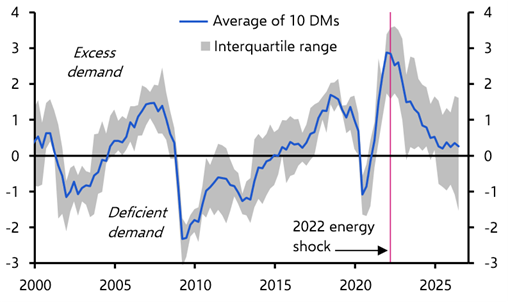
More importantly, the backdrop today is very different from that of the last major energy-induced inflation shock, which followed Russia’s invasion of Ukraine in 2022. Labour markets across the advanced economies are no longer as tight as they were back then and survey measures of excess demand suggest that most advanced economies are running nowhere near as hot as they once were. (See Chart 1.) That should limit the extent to which a rise in energy prices feeds into persistent domestic inflation.
|
Chart 1: Survey Measures of Excess/Deficient Demand (Std. devs.)* |
|
|
|
*Standard Deviations from 2000-2019 average Sources: LSEG Data & Analytics, Capital Economics |
Understanding the reaction function
Even so, policymakers are unlikely to ignore a sustained rise in oil prices, even if the risk of second-round effects remains limited. Forecasting central banks has always involved more than simply assessing the economic outlook. It also requires understanding their reaction function. Having been caught on the back foot during the inflation shock of 2022, central bankers are understandably wary of making the same mistake again.
A single 25-basis point increase in interest rates would do little to alter the inflation outlook. But if the Iran war continues and Brent crude were to climb towards, say, $120 per barrel over the summer, policymakers would come under increasing pressure to demonstrate that they remain committed to their inflation targets. In that sense, developments in the Middle East matter more for the near-term outlook for monetary policy than almost any piece of incoming economic data. If tensions ease and oil prices retreat, central banks can largely look through the inflation shock. But if the conflict continues and energy prices continue to rise, they will increasingly feel compelled to respond.
Another way in which the US is exceptional
Yet while markets continue to price broadly similar policy-rate paths across the major advanced economies over the next year – currently just over 50bps of hikes in the US, UK and euro-zone by mid-2027 – their economic backdrops are becoming increasingly different.
In the UK and the euro-zone, underlying domestic inflation pressures are much weaker. While the latest data has revealed some signs of stabilisation in the UK labour market, we expect unemployment to start edging back up again over the second half of this year. Against that backdrop, if an off-ramp can be found in Iran and oil prices fall back, it is difficult to justify the tightening that markets are pricing in over the next 12 months. We continue to think the Bank of England and the ECB will ultimately deliver less tightening than investors currently expect.
The US looks different. Admittedly, the latest inflation CPI and PPI data have been a bit softer and June’s income and spending numbers, due this week, are likely to show a relatively modest increase in core PCE prices of just under 0.2% m/m.
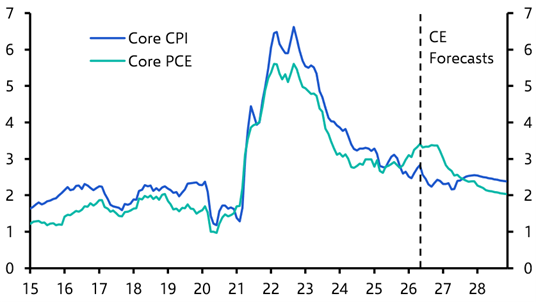
But underlying inflation pressures in the US are stronger than among its peers. In year-on-year terms, core PCE inflation is likely to be about 3.3% in June – well above the Fed’s 2% target. Fiscal policy remains significantly looser than in Europe, while investment linked to AI is adding to demand – and boosting prices of technology goods – rather than acting as a disinflationary supply boost. We expect core PCE inflation to remain above the Fed’s target over the next year, and that means it is likely to have to tighten policy. (See Chart 2.)
Accordingly, while the Fed will in all likelihood leave rates unchanged this week, we expect it to resume tightening before long. On balance, regardless of what is happening in the Middle East, a rate hike at September’s Fed meeting looks likely.
|
Chart 2: US Core Inflation (% y/y) |
|
|
|
Sources: LSEG, Capital Economics |
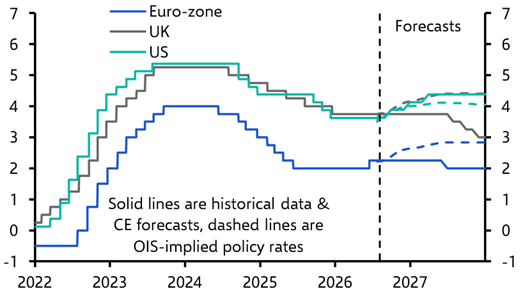
For now, markets continue to price the Fed, the Bank of England and the ECB as though they are on similar policy trajectories. We doubt that will last. In our baseline scenario, in which an off-ramp is found in Iran, and global energy prices drop back, we forecast a renewed divergence in policy, with the Fed raising interest rates three times by mid-2027 but the Bank of England staying on hold and the ECB reversing its rate hike from earlier this year. (See Chart 3.) What’s more, we think there’s a good chance the Bank of England will start to cut interest rates in the second half of next year. That would leave investors facing an autumn in which there is a significant repricing of interest rate expectations – and potentially renewed support for the US dollar.
|
Chart 3: Policy Rates (%) |
|
|
|
Sources: LSEG, Capital Economics |
Note: We’re holding an online Drop-In briefing on the latest Fed, ECB and Bank of England decisions on Thursday, 30th July. Register here.
In case you missed it
Fiscal spending in China fell at its fastest rate in three years last month. Leah Fahy explains why it should rebound, but also why the strength of the fiscal impulse this year may still disappoint.
Ahead of this week’s earnings reports from hyperscalers Amazon, Meta and Microsoft, John Higgins assesses whether there is still life in the AI narrative as a catalyst for further gains in the S&P 500.