The outages at Microsoft and the decision by the FAA to ground all US flights on Friday are unlikely to cause significant economic damage, not least because they were relatively short-lived. But they fit into a broader pattern of increasingly frequent supply shocks that are hitting the global economy. The most consequential was the COVID pandemic. But this was followed by the energy shock triggered by Russia’s invasion of Ukraine in 2022, disruption to Red Sea shipping in 2023, the tariff shock of 2025 and the Iran War and associated disruption to shipping through the Strait of Hormuz this year. It is difficult to escape the conclusion that supply shocks are becoming more common.
Not all shocks are equal
The economic consequences of these shocks have varied considerably. The closure of the Red Sea barely caused a ripple in the economic data. In contrast, the damage caused by the pandemic was enormous. Accordingly, it is helpful to have a framework for thinking about the economic consequences of supply shocks.
The starting point is to recognise that of the various supply shocks that have affected the global economy in recent years, the pandemic was extremely unusual insofar as it forced the effective shutdown of large parts of the economy for an extended period. While the consequences were severe, it is perhaps best treated as a separate case. The pandemic aside, the supply shocks that cause the greatest economic damage exhibit one or more of three characteristics.
A framework for thinking
The first is that they generate a large shift in relative prices, creating economic winners and losers. This is the essence of supply shocks transmitted through energy markets. But the scale of the price shift depends on the nature of the disruption.
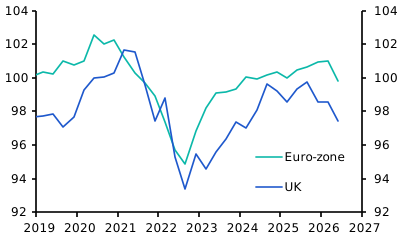
One reason the global economy has proved relatively resilient to the disruption to energy supplies caused by the Iran war is that it has not generated as large a shift in relative energy prices as the shock that followed Russia’s invasion of Ukraine in 2022. This is reflected in the fact that the deterioration in the terms of trade of European economies that are major energy importers has been considerably less severe this time around. (See Chart 1.)
Chart 1: Terms of Trade (2021 = 100) |
 |
| Sources: LSEG Data & Analytics, Capital Economics |
The key difference is the nature of the supply disruption. Middle Eastern oil supplies have proved relatively adaptable, with producers able to reroute shipments and, in some cases, increase production elsewhere.
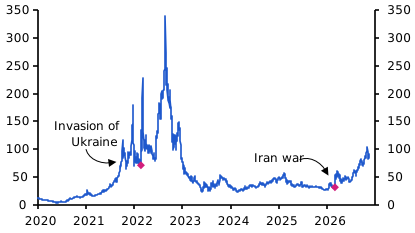
That was much harder following Russia’s invasion of Ukraine. Much of the disruption then centred on natural gas, which Russia supplied to Europe through dedicated pipelines. Russia was effectively a monopoly supplier to parts of the European market, while alternative sources, including LNG, were limited. There was no easy way to replace the lost supply. The increase in European natural gas prices that followed Russia’s invasion of Ukraine was therefore roughly three times larger than that which has followed the Iran War. (See Chart 2.)
Chart 2: European Natural Gas Prices (TTF, € per MWh) |
 |
Sources: LSEG Data & Analytics, Capital Economics |
The second characteristic of damaging supply shocks is that they cause a significant and sustained reduction in the supply of a critical input. The disruption to shipping through the Red Sea in 2023 did not cause major economic damage because most goods could be rerouted, albeit at additional cost. The disruption did not amount to a meaningful reduction in the global supply of those goods.
The 2011 earthquake and tsunami in Japan provides a useful contrast. The damage caused a sharp contraction in domestic production, with Japan’s economy shrinking by more than 3% in the first half of 2011. But the disruption also spread to global manufacturing through shortages of intermediate goods, some of which were produced by effectively monopoly suppliers in Japan. Toyota’s domestic production collapsed but shortages of Japanese-made parts also forced its factories in North America to operate at just 30% of capacity for several weeks.
The lesson is that supply shocks affecting a single point of failure, or a monopoly or near-monopoly supplier of a critical input, are likely to have a disproportionately large economic impact. The most obvious risks today relate to China's dominance in the supply of rare earths and other critical minerals and the concentration of semiconductor production in Taiwan. A disruption to either - but particularly chips - could have significant consequences for the global economy.
The third way in which supply shocks can cause substantial economic damage is that they cause significant and sustained dislocation in the financial system. The most obvious risk here is a technological or cyber attack on critical financial infrastructure, particularly payment systems. Given the interconnected nature of modern financial markets, disruption in this area could quickly spread well beyond the initial point of failure.
The broader point is that supply shocks are not created equal. Their economic consequences depend on their nature, scale and duration. Some, such as the Microsoft outage and the grounding of US flights on Friday, are likely to have limited effects. Others, particularly those that affect monopoly suppliers, critical inputs or the infrastructure underpinning the financial system, have the potential to cause much greater damage.
Supply shocks are stagflationary
Three other points are worth stressing. First, supply shocks are typically stagflationary. By reducing supply, they tend to raise prices while weighing on output. This creates a particular problem for policymakers and central banks: looser monetary or fiscal policy may do little to stimulate output while adding to inflationary pressures. Indeed, central banks often find themselves having to raise interest rates in the face of supply shocks, despite weakness in the real economy.
Second, the sources of supply shocks are changing. Some are technological in nature, as last week's disruptions illustrate. Geopolitics is also likely to become a more important source, particularly as US-China competition intensifies and both sides seek to gain control over critical points in global supply chains.
Third, the growing frequency of supply shocks is likely to encourage governments to place greater emphasis on economic resilience. Building redundancy into supply chains, diversifying sources of critical inputs and protecting essential infrastructure all come at a cost. That cost is manageable if resilience is built gradually, but will be considerably higher if governments are forced to act rapidly in response to a crisis. Either way, greater resilience is likely to add to the fiscal burdens facing governments.