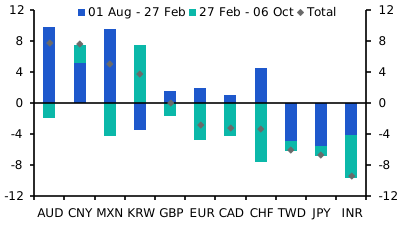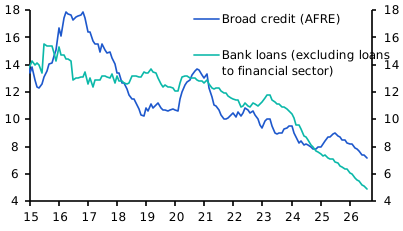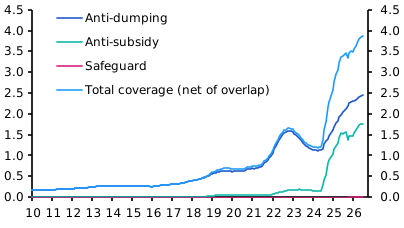
This note summarises the key conclusions from our recent series on China Shock 2.0. The ongoing shock is not simply a repeat of the original China shock of the 2000s. China is once again increasing its share of global manufacturing and exports but it is now competing at the technological frontier, pursuing greater economic and technological self-reliance, and doing so in an increasingly fractured geopolitical environment. It is also a much larger economy. This means that the effects of China’s export push are being felt more widely, and that the adjustment required elsewhere will be more difficult.
A deliberate choice
China’s latest export surge is the product of deliberate policy choices in Beijing. It forms part of a broader strategy of increasing China’s technological self-sufficiency while making the rest of the world more dependent on Chinese production. These policies carry costs for China itself. Excess capacity and weak domestic demand are weighing on productivity and, ultimately, on long-term growth. But those costs are tolerable because they serve wider strategic objectives.
It would therefore be a mistake to assume that China will change course simply because its current strategy imposes economic costs at home. On the contrary, China is likely to continue on its current course for several years, competing aggressively at the global technological frontier and gaining market share from advanced economies even as the structural slowdown in its own economy continues. The combination of slower economic growth and rising export competitiveness is not a contradiction. It is a defining feature of China Shock 2.0.
This time is different
There are important similarities with the original China shock. China is again exporting large quantities of manufactured goods, putting downward pressure on prices in global goods markets and contributing to disinflation in the rest of the world. But there are three important differences.
The first is scale. China now accounts for just under one-fifth of global goods exports, compared with just over 5% in the early 2000s. The rest of the world is therefore much more exposed to developments in China.
The second difference is China’s position in the value chain. In the 2000s, China was transformed into the world’s low-cost manufacturing hub. Today, Chinese firms compete at the technological frontier, in areas from electric vehicles and batteries to robotics and AI.
The third difference relates to geopolitics. In the 2000s, China became a competitor to advanced economies but was not viewed in Washington as a strategic rival. Indeed, there was confidence that economic integration would pull Beijing into Washington’s geopolitical orbit. China Shock 2.0 is unfolding against a geopolitical backdrop that has become more fractured as Western hopes for a more politically liberal China have died.
Some benefits…
None of this means that the shock is entirely negative for the rest of the world. There are benefits. As noted earlier, China’s excess manufacturing capacity is exerting downward pressure on global goods prices, making China an important disinflationary force. We estimate that this will reduce global inflation by around 0.1-0.2 percentage points over the years ahead. Consumers are also gaining access to a wider range of increasingly sophisticated goods at lower prices.
The relocation of some production away from China is creating opportunities for economies elsewhere, particularly in South East Asia. Vietnam has been a prominent beneficiary, while Malaysia and other economies are also gaining from the diversification of supply chains.
…but more significant costs
But these benefits need to be weighed against four broader concerns. The first is China’s growing dominance in high-tech production. These sectors are highly productive, create well-paid jobs and are important drivers of innovation. Governments also often regard them as strategically important. Losing market share in these industries is therefore more damaging than losing it in low-end manufacturing.
The second is the loss of market share for advanced economies. Some European economies, particularly Germany, are exposed because of their reliance on manufacturing sectors where Chinese firms are becoming stronger. We estimate that China Shock 2.0 could reduce euro-zone GDP growth by around 0.1–0.2 percentage points a year, with the impact on Germany likely to be larger. This is also likely to entail large manufacturing job losses.
The combined effects of weak growth in Europe and China’s continued industrial expansion are likely to strengthen support for populist political parties. Economic nationalism and active industrial policy are therefore likely to become lasting features of the political and geopolitical landscape over the next decade.
The third concern relates to economic resilience and supply-chain security. For much of the past four decades, the received wisdom among policymakers was that the supply side of economies should be organised to produce goods and services as efficiently as possible. China’s increasingly dominant position in important supply chains, combined with its emergence as a strategic competitor to the US, will mean that governments and firms place greater emphasis on improving economic security and resilience rather than simply maximising economic efficiency. This will require difficult trade-offs across a broad range of policy areas, including the response to climate change.
The fourth concern is that China Shock 2.0 is causing global trade imbalances to widen. The nature of China’s growth model, which prioritises production over consumption, is that its export surge has not been matched by a comparable increase in imports. As a result, its current account surplus has risen to a record level relative to global GDP. This must be matched by deficits elsewhere, the largest of which is run by the US.
Widening global trade imbalances were also a feature of the first China shock. But unlike in the mid-2000s, the source of concern in the US is not private sector borrowing: US firms and households are now net savers. Instead, it is the public-sector deficit. That creates a direct link between China Shock 2.0 and concerns about fiscal sustainability in the US.
The best way to resolve these imbalances would be via a modern-day “Plaza Accord” that coordinated policy changes in both China and the US. But the scale of the adjustment would be considerable. We estimate that the renminbi is undervalued by around 25% in real terms. What’s more, exchange rate adjustment alone would not fully resolve imbalances. Without measures to boost domestic demand, a stronger renminbi would simply deepen deflation in China. At the same time, the US would need to reduce its fiscal deficit alongside measures by China to stimulate its economy. Otherwise, stronger aggregate demand at a global level would add to world inflation.
The difficulty is that coordinated adjustment is currently highly unlikely. The Plaza Accord was difficult to sustain even among allies. Today’s imbalances involve strategic rivals. There is little appetite for fiscal consolidation in the US, while there are few signs that Beijing is preparing to abandon its current economic strategy. Accordingly, the most likely outcome is that these imbalances continue to build – and the longer they do so, the bigger the risk that all of this ends in some form of crisis.
So where does that leave us? Our series argues that China Shock 2.0 reflects deliberate policy choices in Beijing that will not change soon. While some economies – notably in South East Asia – will benefit as production shifts out of China, producers in many advanced economies will continue to lose global export market share, with Europe particularly exposed. The fallout will extend beyond trade. China Shock 2.0 is adding to the geopolitical strains that are reshaping the global economy. And it is driving large imbalances in global trade that are creating financial vulnerabilities. Left unchecked, these could sow the seeds of the next global crisis. That outcome is not yet inevitable. But without a fundamental shift in policy in Beijing or Washington, it is the path on which the world economy is set.
In case you missed it
We are delighted to partner with Fathom Consulting to launch China Scenarios – a quarterly scenarios service for China’s economy. To receive this on a complimentary basis, click here.
Our UK team set out what to watch for in this month's Budget.