Major moves in financial markets tend to send investors in search of a single narrative to explain them. But the rise in bond yields over the past few months has no such single explanation. Indeed, one of the more important features of the sell-off – which has intensified over the past week – is that the forces driving it appear to have shifted.
Shifting sands
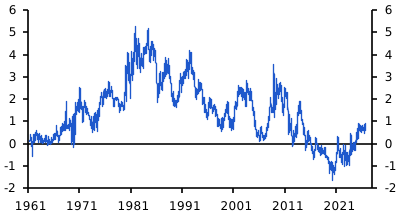
In the early part of this year, the sell-off was driven primarily by rising term premia. This is the additional compensation investors require to hold long-term government debt, over and above the expected path of short-term interest rates over the lifetime of the bond. Chart 1 shows that the term premium component of the 10-year US Treasury yield increased significantly over the first half of this year.
Chart 1: ACM Estimate Of 10 Year Treasury Term Premium (%) |
 |
Sources: LSEG Data & Analytics, Capital Economics |
Because the term premium represents the component of a bond yield that cannot be explained by the expected path of short-term interest rates, it is difficult to identify precisely what drives it. But the rise in term premia at the start of this year coincided with growing concerns about fiscal sustainability across advanced economies. It therefore seemed reasonable to attribute at least part of the rise in yields to heightened fiscal concerns.
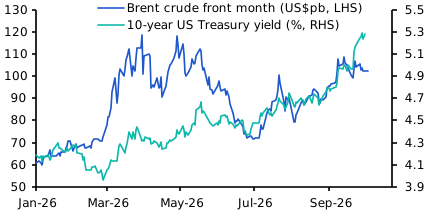
The main driver then changed. From around July, the rise in bond yields increasingly tracked developments in the oil market and appeared to reflect the anticipated impact of higher energy prices on both inflation and policy rates. (See Chart 2.) This phase of the sell-off was therefore primarily a response to the unravelling of the MOU with Iran, renewed disruption to oil shipments through the Strait of Hormuz, and expectations of an associated rise in inflation and interest rates in advanced economies.
Chart 2: Oil Price & 10-Year Treasury Yield |
 |
Sources: LSEG Data & Analytics, Capital Economics |
Unpacking the latest rise in yields
Over the past week or so, there has been yet another shift. Ten-year US Treasury yields have continued to rise, but this has happened alongside a flattening-off in oil prices. (See Chart 2 again.) Higher oil prices – and, by extension, higher inflation and short-term interest rate expectations – therefore do not appear to explain the latest move in yields.
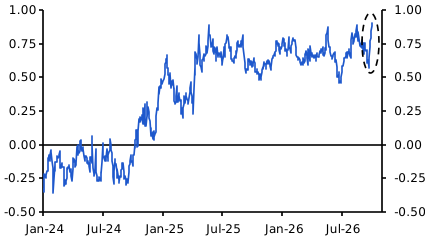
Instead, term premia have started to rise again. This is clear in Chart 3, which repeats Chart 1 over a shorter time period and makes the latest move easier to see. In the US, however, it is harder to attribute this to fiscal concerns. There have been no obvious developments in recent weeks that would explain a renewed deterioration in perceptions of fiscal sustainability. An alternative explanation is that the rise in US term premia reflects technical factors, including portfolio rebalancing by large funds ahead of the end of the third quarter.
Chart 3: ACM Estimate Of 10 Year Treasury Term Premium (%) |
 |
Sources: LSEG Data & Analytics, Capital Economics |
But fiscal concerns have increased in other countries in recent weeks, nowhere more so than in France. The French government recently acknowledged that it will miss this year’s deficit target and this week it presented a budget to parliament for next year that relies on substantial expenditure cuts but which would still leave the deficit at an unsustainable level. All of this is against the backdrop of an economy that stalled in the first half of this year and fears of a shift towards greater fiscal populism following next year’s presidential election.
The path ahead
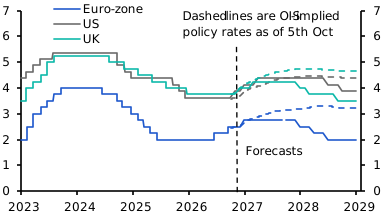
So what happens next? The encouraging news for bond investors is that markets may now be overdoing the extent to which they expect central banks to tighten policy. At present, markets are pricing in at least three more 25bps hikes in the fed funds rate over the next year, whereas we expect only two more 25bps hikes to a target range of 4.25-4.50%. Likewise, in the euro-zone we do not expect the ECB to raise interest rates as much as markets currently expect. Nor do we expect the Bank of England to tighten policy to the extent currently priced in. (See Chart 4.)
Chart 4: Policy Interest Rates (%) |
 |
Sources: Capital Economics |
All else equal, this should provide some relief to bond markets. But, of course, all else is not equal. The bigger risk to bond markets over the next 12 months is probably less about central-bank policy – and therefore the expected path of short-term interest rates – and more about fiscal concerns and the potential for a further rise in term premia.
Returning to Chart 1, on the ACM measure at least, the term premium on 10-year US Treasuries has risen by more than 200bp from its low at the end of 2020. But it remains low by historical standards. There is therefore plenty of scope for it to rise further. If we are right in thinking that central banks will now raise interest rates by less than investors expect then there may be some light at the end of the tunnel for bond markets. But continued fiscal vulnerabilities – particularly in the US, France, Italy and the UK – suggest that the foundations underpinning government bond markets are likely to remain shaky for some time.