Last week saw a flurry of macro developments including the renewed closure of the Strait of Hormuz, a series of speeches from Fed officials and the first signs of the UK government’s new economic team. This might explain why one of the more significant releases – China’s Q2 GDP data – received relatively little attention.
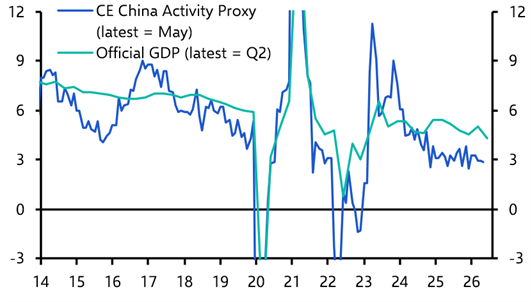
At first glance, the figures looked underwhelming. Official GDP growth slowed from 5.0% y/y in Q1 to 4.3% in Q2. But the headline is perhaps less significant than it appears. We place little weight on the official growth rate itself. More notable is that it has moved closer to our own in-house measure of economic activity, perhaps suggesting that the authorities are becoming more willing to report data that better reflect conditions on the ground. (The latest reading of our China Activity Proxy puts growth at around 3.2% y/y in May.) (See Chart 1.)
|
Chart 1: Official China GDP & Capital Economics’ China Activity Proxy (% y/y) |
|
|
|
Sources: WIND, CEIC, Capital Economics |
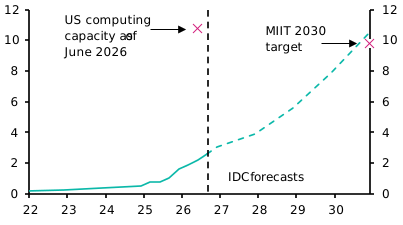
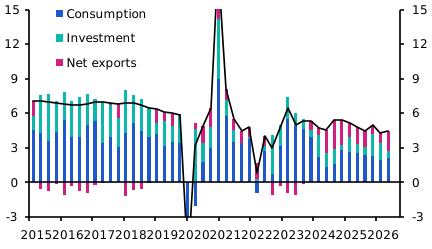
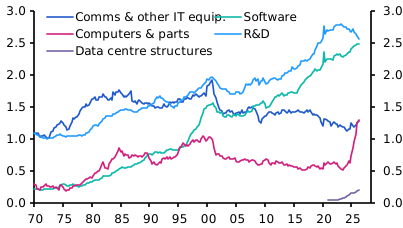
The more interesting story lies beneath the surface. The production breakdown of GDP suggests that AI is becoming an increasingly important driver of growth. While it is difficult to be precise, we think that more than half of quarter-on-quarter GDP growth in Q2 can be attributed, directly or indirectly, to AI-related activity. To put that into perspective, we think that about one-third of growth in the US over the past year can be attributed to AI. In other words, growth in the world’s two largest economies is now being driven, to a significant extent, by AI. What should we make of this?
First, the AI boom still appears to be in its early stages. We find it useful to think about the macroeconomic effects of AI in three phases. (See Chart 2.) The first is the activity associated with the development of the models themselves. The second is the investment required to build and deploy the supporting infrastructure. The third is the growth dividend as firms adopt the technology more widely and total factor productivity rises.
|
Chart 2: Timeline of the AI revolution |
|
|
|
Sources: Capital Economics |
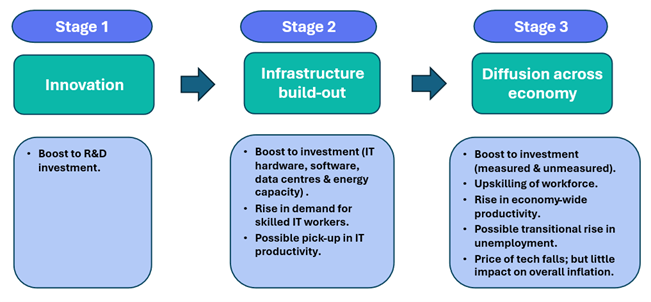
In our view, we are currently somewhere around the second phase. The productivity gains that ultimately matter most for long-term growth are still largely ahead of us. The contribution AI has already made to growth is impressive, but the larger benefits are likely to come later.
Second, the gains so far remain concentrated in the US and China, plus a small number of economies including Korea and Taiwan that produce AI hardware. Elsewhere, AI has made only a modest contribution to growth. For example, we estimate that it has added only around 0.1-0.2% to GDP in the UK and euro-zone over the past year. The reason is that the first two phases of the AI cycle - developing frontier models and investing in infrastructure - are taking place overwhelmingly in the US and China. Other economies should benefit eventually, but they are not yet at the centre of the investment cycle. That is one reason why our long-run growth forecasts continue to favour the US over Europe. (In China, while AI will boost growth, this is likely to be offset by deepening structural headwinds - including from demographics - that we think could still push GDP growth to just 2% a year in the 2030s.)
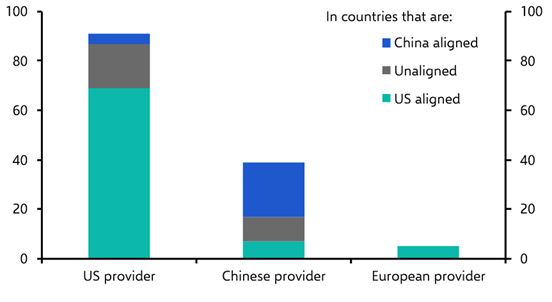
Third, the AI race is becoming another fault line in the global economy. As AI ecosystems become more embedded, countries are increasingly aligning with either US or Chinese technology. Most advanced Western economies are adopting US models and infrastructure, while many emerging economies - particularly those with closer geopolitical ties to China - are turning to Chinese alternatives. Cost plays a role, but national security considerations are becoming increasingly important. The result is that AI is emerging as another dimension of global economic fragmentation. It is striking that those countries that align with the US in our fracturing map overwhelmingly use US cloud computing, while those that align with China are more likely to use Chinese cloud technology. (See Chart 3.)
|
Chart 3: Nationality of Cloud Computing Provider (No. of Countries, Jan. 2026) |
|
|
|
Sources: Hawkins et al., Capital Economics |
Finally, while the macroeconomic benefits of AI are likely to build, we think the AI-related boom in financial markets - and particularly US tech stocks - is at a much later stage. Our more cautious stance on US equities is not primarily about valuations. Rather, it reflects the difficulty of sustaining the exceptionally strong earnings expectations currently embedded in markets. Having been among the most bullish forecasters of US equities for the past three years, we think the balance of risks is becoming less favourable.
In case you missed it:
William Jackson identified the EM central banks that are most likely to hike interest rates.
Jack Allen-Reynolds argued that indirect inflation effects of higher energy prices are still largely absent in the euro-zone.
Vicky Redwood provided a framework for how to think about the impact of AI on inflation.