The sharp sell-off in equity markets at the end of last week has raised an obvious question: has the AI boom turned to bust?
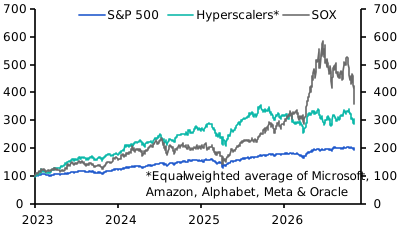
In one sense, the correction has been under way for some time. Share prices across key parts of the AI complex peaked well before last week. The Philadelphia Semiconductor Index (SOX), which tracks chipmakers, peaked in June and has since fallen by around 35%. The top five hyperscalers have fared better but are still down about 10% on average since early October (see Chart 1). The scale of Democratic victories in the midterms, and the prospect of greater regulatory scrutiny, may have provided the trigger for the latest sell-off. But the weakness in AI-related stocks predates it.
Chart 1: US equity Indices (1st Jan. 2023 = 100) |
 |
Sources: LSEG Data & Analytics, Capital Economics |
Flashing red
The question now is whether the correction spreads to the wider market. Until last week, other parts of the equity market had held up relatively well. Indeed, share prices for most S&P 500 constituents rose in October, despite the weakness in technology stocks. But having been bullish on equities since 2023, we cautioned over the summer that the broader stock market rally may be entering its final stages.
In particular, we noted that the US equity market was now exhibiting several of the characteristics typically associated with an approaching peak. Index concentration was unusually high, earnings expectations were elevated, investment intentions among US firms were extremely strong and issuance of new equity was surging. On a 12-month forward basis, price/earnings ratios were stretched but not excessive. But on Shiller’s CAPE measure the S&P 500’s P/E ratio was at its highest since early 2000. And while stock market leverage, as measured by margin debt, was not particularly high, that measure does not account for new forms of leverage, such as options and ETFs. In short, most important indicators that had signalled previous market peaks were pointing to a market that once again was nearing its top.
Further air is likely to come out of the technology sector, not least because earnings expectations still look demanding. But the fate of the broader market will depend to a large extent on the performance of the economy.
The economy remains resilient
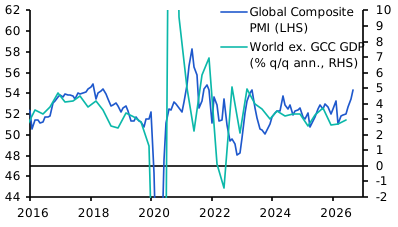
For now, the global economy remains resilient. Global PMIs have strengthened and are consistent with an acceleration in growth in the second half of this year. (See Chart 2.) The US economy, in particular, is holding up well. GDP grew by 3.4% q/q annualised in Q3. The jobs numbers for November, released on Friday, underscored that the labour market remains strong.
Chart 2: Global Composite PMI and GDP |
 |
Sources: LSEG Data & Analytics, Capital Economics |
But the same concerns that are weighing on technology stocks are also starting to cast a shadow over the economic outlook. In particular, questions are growing about the sustainability of the AI capex boom in the real economy. This boom in AI-related investment, coupled with the wealth effects associated with the run-up in the equity market, has accounted for between one-quarter and one-third of US GDP growth over the past year.
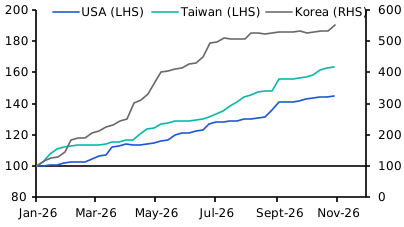
Meanwhile, a surge in goods related to the AI investment boom has been a key reason why world trade has remained resilient in the face of the global energy shock caused by the Iran War. Exports from Korea have increased by 90% (in value terms) over the past year, while those from Taiwan have grown by just under 80% y/y. These are extraordinary increases - and they raise questions about how much longer the current pace of expansion can be sustained.
A high hurdle
On its current trajectory, the stock of AI-related investment is on track to exceed $5 trillion by the end of this decade. Even making relatively conservative assumptions about the revenues needed to justify that investment, the companies involved would need to generate an additional $1.7 trillion to $1.9 trillion in annual revenues to deliver the required returns. That compares with around $150 billion of annual AI-related revenues today.
AI should eventually drive significant gains in productivity and we remain bullish on its economic potential over the medium-term. But this boost to productivity is unlikely to be sufficient to fully deliver the additional GDP and income growth needed to generate revenues on this scale. That leaves two possibilities: that capital’s share of income, which is already high, must rise further; or that AI companies must capture a much larger slice of capital’s existing share of income. Neither is impossible but, as we argued in a major report last week, both represent a considerable hurdle. Accordingly, there are good reasons to question whether the current boom in AI investment can be sustained.
The fallout
If investment does turn, the consequences for the US economy could be significant. As noted above, AI-related capital expenditure has become an important prop to growth. A reversal would remove some of that support and could knock around 0.3%-pts off GDP growth.
The good news is that, unlike the housing bubble in the mid-2000s, where excessive leverage in the banking system created a systemic financial crisis, we do not expect the same today. What’s more, in contrast to the dot-com bubble when the US was a major producer of ICT equipment, most of the AI investment today consists of imported goods, meaning the impact on domestic manufacturing and employment should be more limited. The flip side of this, however, is that the economic fallout is more likely to be felt by the economies supplying the components and equipment underpinning the boom, notably Taiwan and Korea.
Our forecasts already assume that a pullback in AI investment and a fall in the stock market will weigh on US growth as we move through 2027. The latest sell-off may have brought that adjustment forward. But we remain of the view that an end to the AI investment boom is unlikely, in itself, to push the US, or any other G7 economy for that matter, into recession. If we’re right this should limit equity market losses outside the tech sector.
In case you missed it
William Jackson unpacked the economic impact of El Nino on emerging economies
We explained the economic consequences of the ‘blue wave’ in US midterms for America and the rest of the world.
Julian Evans-Pritchard explained why the shift in the policy rate used by the People’s Bank of China doesn’t amount to monetary easing.