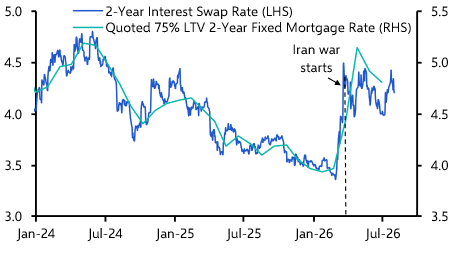

This Weekly Roundup highlights our latest key analysis, along with insights from our new Global Economic Outlook, which updates our forecasts under a baseline scenario of a short-lived Middle East conflict, alongside an adverse scenario featuring prolonged fighting.
1. Forecasting in a fog of war
In our baseline scenario, a brief conflict lifts global inflation and trims growth but the fall-out remains manageable. A more adverse outcome sees sustained energy disruption lead to recession.
Fighting ends within weeks under our baseline and oil prices fall over the second half, with Brent around $60pb by year-end, though damage to Qatari LNG keeps prices elevated. A prolonged conflict keeps oil in triple digits through 2027, with EU and Asian gas prices around three times pre-war levels.
Among DMs, the UK, euro-zone and Japan face the largest drags from higher energy prices under the baseline, though none enter recession. The US is more insulated from higher energy prices, as is China, though it continues to face domestic constraints.
The ECB raises rates as early as April, while the Bank of England looks through the spike. The Fed’s 25bp cut shifts to early 2027, while the RBA and BOJ continue tightening. In an adverse scenario, all major central banks raise rates this year, with some continuing into 2027. Government bonds and equities have scope to recover under the baseline, though pre-war equity projections look out of reach.
2. Europe's China shock
China’s impact on Europe has mostly come through weaker exports, higher imports and lost global market share. For Germany, the hit to goods trade is equivalent to 3.2% of GDP and, as this report suggests, trade barriers will continue to rise in response.
3. The bubble (partly) bursts
AI’s economic story is only beginning, but the valuation component of its equity bubble may have already burst. Earnings expectations still provide support, but a meaningful S&P 500 pullback remains a risk if they disappoint.
4. Oil demand after the war
History shows demand destruction after oil shocks is real and lasting. But this time escape routes are narrower. EV running costs rise with power prices, and fertiliser shortages are crimping biofuels. Demand may not fall as much as you’d expect.